Unexpected parenting difficulties

Being a dungeon master for ages 12/12/9 is surprisingly difficult. But so far, they seem to be having fun?

They didn’t have enough of an attention span the first session to do a Session Zero, but they’ve given feedback since then so I think it’s probably enough to go on now? Obviously I’m not hitting any really rough emotional stuff, but even things like “combat, talky stuff, or puzzles?” is surprisingly difficult to maneuver.

This session they all got pets (no magical abilities, just cute pets that follow them around and then run away during combat) so that was a big hit!

Definitely open to (written) suggestions for how to (BRIEFLY) discuss Session Zero topics. 😁

(please no podcasts or videos, due to my own hearing and attention issues!)

Character idea

I am blatantly stealing this from a friend of mine.

I want to play a buddhist lupine that used to sell trinkets seeking an outfit that truly reflects themselves from a pier

They’re an aware weir ware where wear werewolf

Scheduling

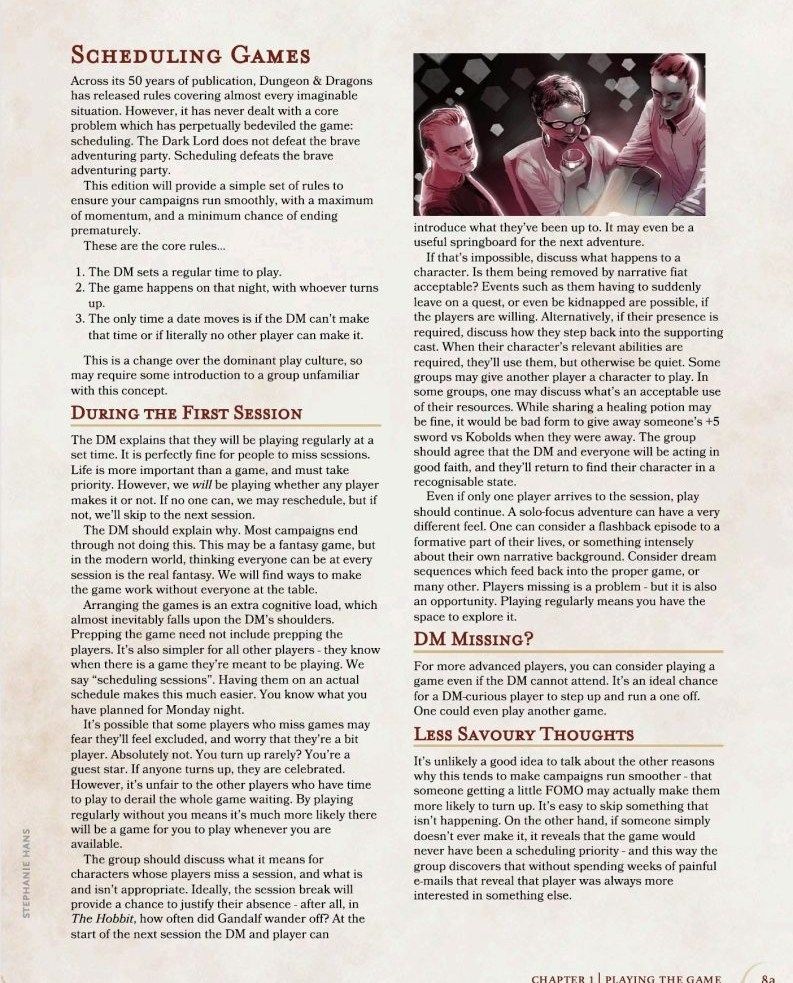
This week I saw a good take on scheduling for D&D.

https://www.polygon.com/tabletop-games/543536/dnd-dungeons-dragons-scheduling-handbook-patch

The Scheduling page the author suggests you print out

After I shared it, someone else sent me this Hank Green video about combinatorics, which explains the issue really well.

Ultimately, I think that people have trouble with D&D scheduling in part because of two of the Geek Social Fallacies: #5, “Friends Do Everything Together” and #1,  “Ostracizers Are Evil.”

But you don’t have to do everything together. Like I talk about in Nuclear Event Planning, it is okay to prioritize “I want to host this event” over “I want these specific people there.” (It’s also okay to do the reverse, but then you have to accept the high likelihood that “hosting the event” won’t happen.)

Shopping local: Gritty Goblin Games

One of the local game stores I like to wander around in, Gritty Goblin has an excellent selection of games, minis, and random accessories. The staff is always pleasant and helpful, despite seeming to consist solely of twenty year old young men, a demographic that has earned somewhat of a reputation for misogyny. Even at my age I still feel a little nervous in that context; so the friendliness is really reassuring.

https://www.grittygoblingames.com/

Shopping local: Three Gear Games

I’ve been shopping and gaming at Three Gear Games and their predecessor store (The Family Game Store) since I moved to Maryland. The owners are friendly, and I love being able to host board game days in the store when I don’t have the spoons to do it in my house. Plus their stock is awesome; not just games, but stuffies and various accessories too.

https://www.3gearstudios.com

What’s your D&D character class and race?

This was a cool personality quiz.

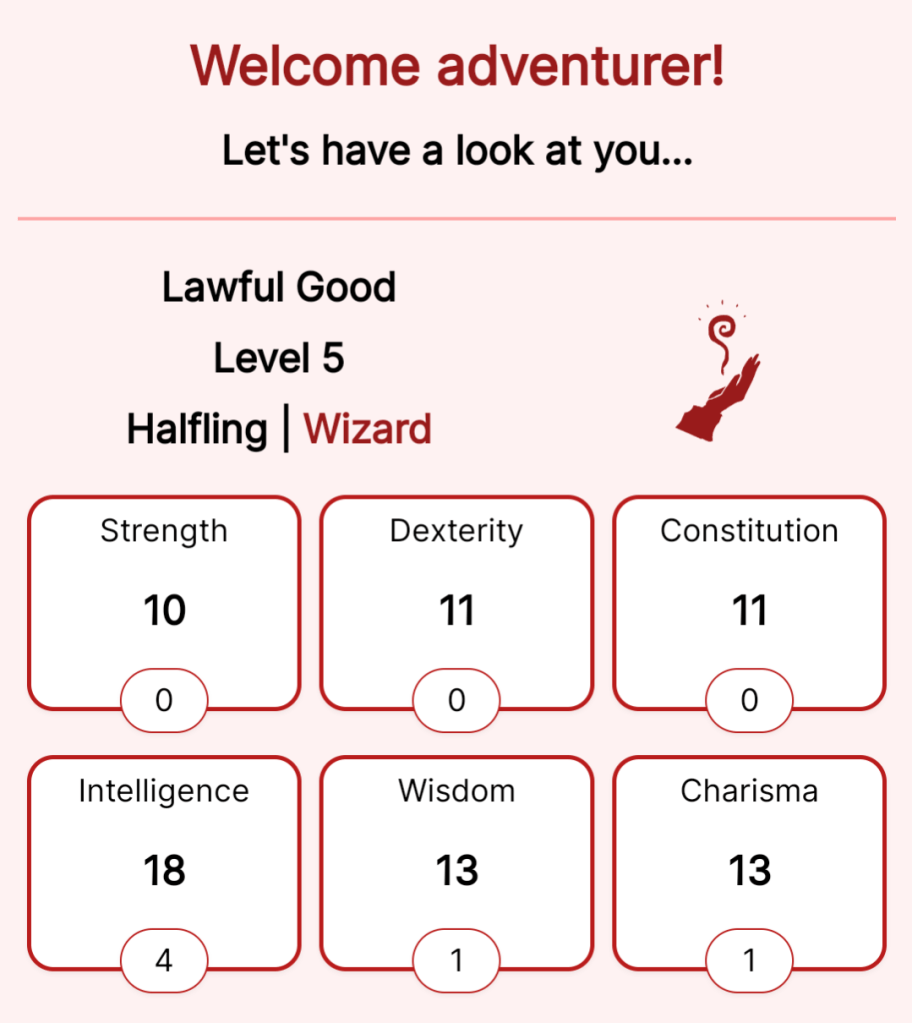
I got Halfling Wizard!

I am a level 5 Lawful Good Halfling Wizard! Find out what kind of D&D character you would be! 

Alignment

Lawful Good – A lawful good character acts as a good person is expected or required to act. They combine a commitment to oppose evil with the discipline to fight relentlessly. They tell the truth, keep their word, help those in need, and speak out against injustice. A lawful good character hates to see the guilty go unpunished. Lawful good is the best alignment you can be because it combines honor and compassion. However, lawful good can be a dangerous alignment when it restricts freedom and criminalizes self-interest.

Race/species

Halfling – Halflings are clever, capable and resourceful survivors. They are notoriously curious and show a daring that many larger people can’t match. They can be lured by wealth but tend to spend rather than hoard. They prefer practical clothing and would rather wear a comfortable shirt than jewelry. Halflings stand about 3 feet tall and commonly live to see 150.

Class

Wizard – Wizards are arcane spellcasters who depend on intensive study to create their magic. To wizards, magic is not a talent but a difficult, rewarding art. When they are prepared for battle, wizards can use their spells to devastating effect. When caught by surprise, they are vulnerable. The wizard’s strength is her spells, everything else is secondary. She learns new spells as she experiments and grows in experience, and she can also learn them from other wizards. In addition, over time a wizard learns to manipulate her spells so they go farther, work better, or are improved in some other way. A wizard can call a familiar- a small, magical, animal companion that serves her. With a high Intelligence, wizards are capable of casting very high levels of spells.

Detailed Results

This section is the scalar values it gave me for each feature (alignment, race, class).

Alignment

Lawful Good (24)

Lawful Neutral (20)

Lawful Evil (10)

Chaotic Good (21)

Chaotic Neutral (17)

Chaotic Evil (7)

Neutral Good (23)

Neutral Evil (9)

True Neutral (19)

Race

Dwarf (6)

Elf (12)

Half-Elf (8)

Halfling (12)

Human (9)

Half-Orc (2)

Gnome (10)

Class

Fighter (10)

Ranger (12)

Paladin (12)

Cleric (10)

Druid (12)

Bard (12)

Monk (14)

Sorcerer (12)

Barbarian (6)

Rogue (4)

Wizard (20)

Warlock (8)

D&D is like relationships

An Internet friend is trying to run a D&D game in her town, but she’s found that one of her players has (what I consider to be) frankly absurd expectations for the game.

Stuff like “what do you mean, the dragon attacked me when I threw a rock at it?” Ma’am, you cannot run around just Pippin Tooking all over the place and expect there to not be consequences! You’re lucky that wasn’t a Balrog! Sorry, I mean legally distinct Balor.

Anyway. My friend was distraught and thought, maybe she did something wrong? Now. I know I’m only getting one side of the story here, and that naturally I’m going to side with my friend. But here’s the deal: It doesn’t actually MATTER if my friend is Right or Wrong. She’s allowed to run a game where she expects the players to more or less behave in reasonable ways, not deliberately screw things over for the other players, etc.

If you want to be a PC who acts in antisocial ways, then that’s a conversation you need to have with your DM ahead of time, ideally during Session Zero. And it’s a good idea for DMs to have an Expectations Document, where they lay out what type of game they expect to run.

For me, one of my general expectations is “no PVP” (player versus player). I find it very stressful to have to navigate between in-character conflict. So if someone else really enjoys PVP and wants to play that style of game, that’s okay – they just can’t do it at my table. It’s a compatibility issue. And maybe their desire for PVP will make it hard for them to find a group to game with. Or alternatively, maybe my desire for a PVP-free group will make it hard for me to find players.

But the most important thing to remember is that nobody is obligated to change their playing style to suit someone else’s wishes. Even if that person’s preferred style changes mid-game.

And relationships are the same way. If you want fundamentally different things – even if you changed your mind about what you wanted after being together for a long time – then it’s not just okay, it’s *positive*, to go your separate ways.

Even if that means you spend a while without a partner.
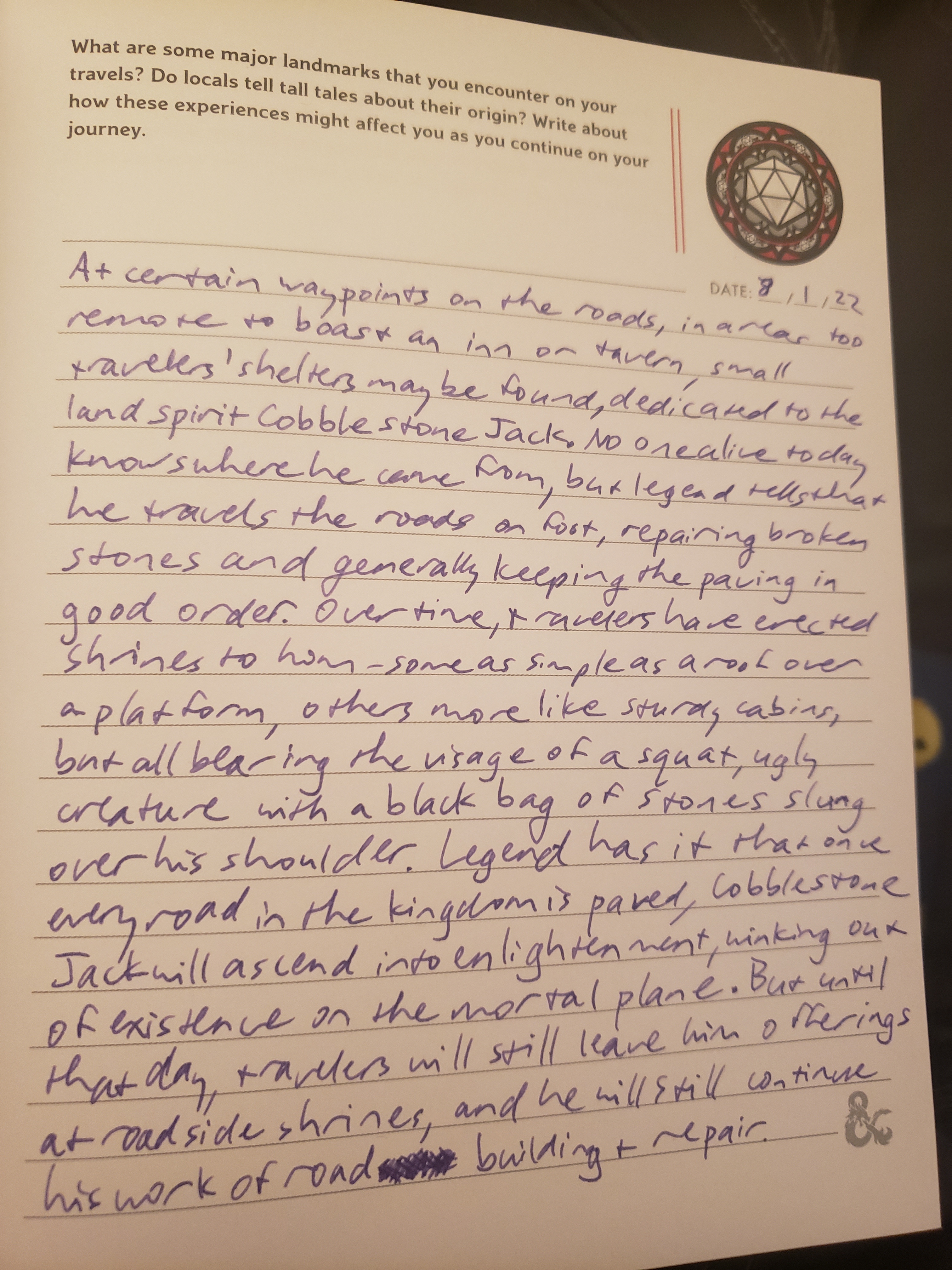
Cobblestone Jack

“hey remember that time you summoned a dretch to interrogate him about his demon lord’s plans and he begged you not to send him back to the Abyss so you gave him a task that was non infinite but might as well be?”

A short D&D concept: Kord’s Arena

Imagine a world in which the church of Kord runs sanctioned fight clubs, where people can do various types of combat sports (such as boxing, wrestling, feats of strength, etc) to the greater glory of the god.

Doping/non-doping (magic/non-magic) options are available: the national or international level Non-Magical championships would take place in a large arena with an Antimagic Field cast over the fighting area. For the Magical championships, a facilitator with Detect Magic or a similar spell on would identify and announce each spell present on the competitors immediately before the match.

Each arena, even the smallest, would be staffed by a low-level cleric or paladin of Kord who tends wounds after the match.

This concept can easily be expanded to other deities in other pantheons, e.g. Tulkas.