Owl? Lark? Pigeon?

Some people are morning larks. They wake up early and go to bed early.

Some people are night owls. They stay up late and wake up late.

I have found, as I grow older, that I really need more sleep than I give myself. I can’t stay up until all hours of the night anymore, but waking up is still very difficult.

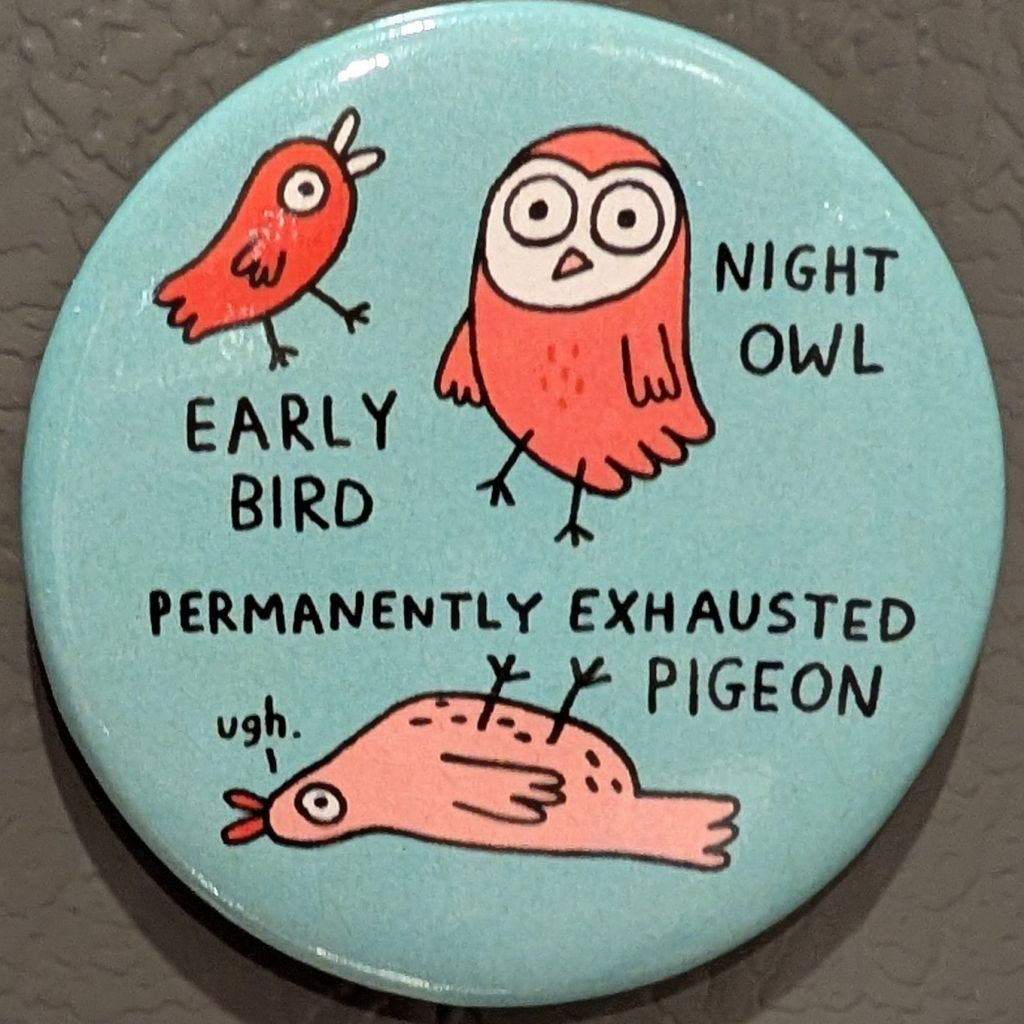
Per this magnet I found: I am clearly a Perpetually Exhausted Pigeon.

Permanently Exhausted Pigeon

Dalmatians and Bassets

One of my friends this weekend said that it’s rough being the parents of a Dalmatian child when your friends have Basset Hound children, because we end up giving them useless advice, like “Why not just have them sit and play video games?” when the kids will not sit still for that.

(This came up when I expressed surprise at a hotel room/suite not being sufficient for a family trip. My child is a quiet Basset Hound.)

An octopus wearing a hat

Many years ago, I had a friend who tended to split things into either Good Thing or Bad Thing.

This went not just for things/ideas, but also for people.

And because they split the world into these categories, they also assumed that everyone else split the world the same way: there was no room for shades of grey, in their worldview.

On one memorable occasion, they posted about a very ambitious home renovation project; I suggested they take a carpentry class at Home Depot before jumping into the project, and they accused me (and everyone else who commented on the post) of being a malicious saboteur of their projects, and ended the screed with “Do you think I’m smart and competent, or do you think I’m an octopus wearing a hat?”

Friends: there is a lot of daylight between those two things.

I think about that conversation whenever I am tempted to split the world into black and white, good and bad, yin and yang. (Okay, maybe not that last.) It’s possible to receive criticism without assuming the critic hates you and thinks you’re wholly incompetent.

Time types

Several years ago, a friend introduced me to the concept of “Social Time vs Normative Time.”

“Normative Time” is the idea that things happen at certain times: dinner is at 6, the meetup officially starts at 5, things like that. It’s generally considered to be the default time system in America.

“Social Time” is something that I’ve more often seen in the context of specific places: Moroccan Time, Island Time, Greek Time. Time is more fluid; you get there when you get there; you don’t stress if you’re late or your friend is late.

I, myself, am a Normative Time person who is very bad at it.

Today I was reminded of the Captain Awkward column on Perpetual Time Optimism because Reddit shared it with me. It gets a bit spicy in there (in both).

In general, in my life, I try to strike a balance between both types of time. I’m sympathetic to the time blind people; I’m often late to things, and it takes me a LOT of effort to do all the things to get to something early, especially if it’s already early in the morning. But I also want to be able to do things like “see a movie” and “eat at a restaurant” and so forth! So in general I try not to invite the very time blind person to things where “being late” would put a cramp in someone ELSE’S day.

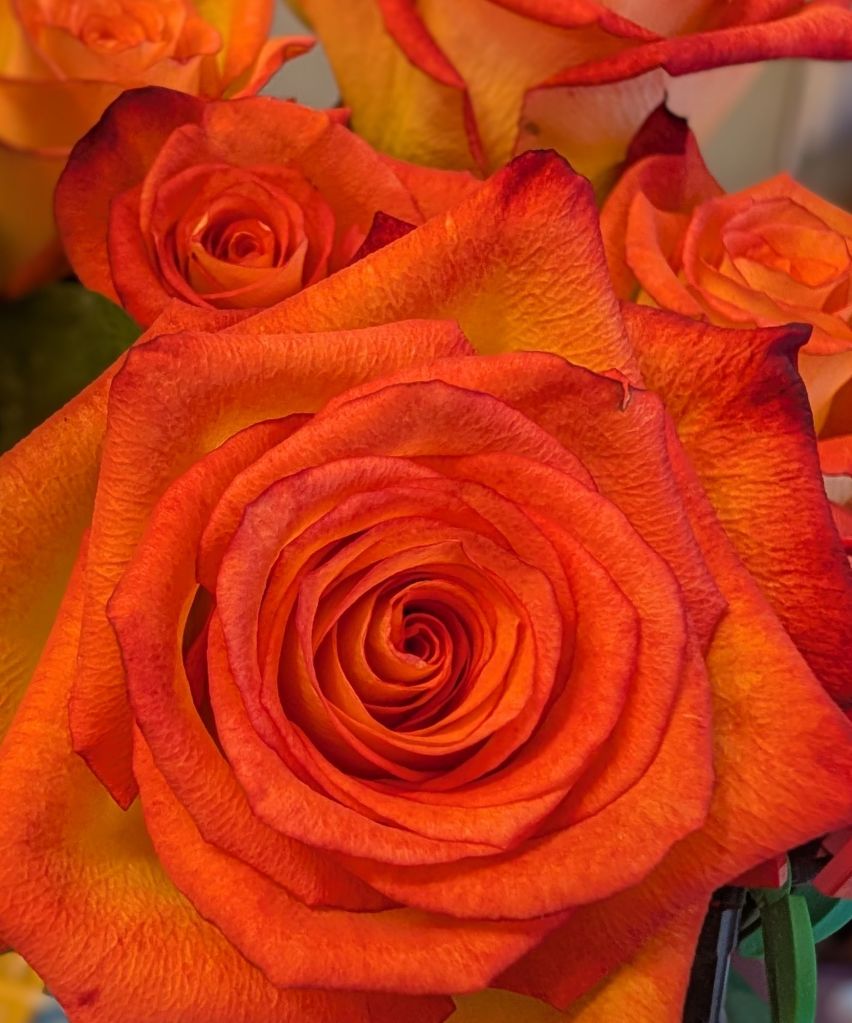
An orange rose

I remember, years ago, reading a poem about how red roses are for passion, and white roses are for committed love; so the ideal rose for a relationship is one that’s mostly white but with a blush of red on the tips of the petals.

That may be ideal for some people! But I would hesitate to claim it works best for everyone.

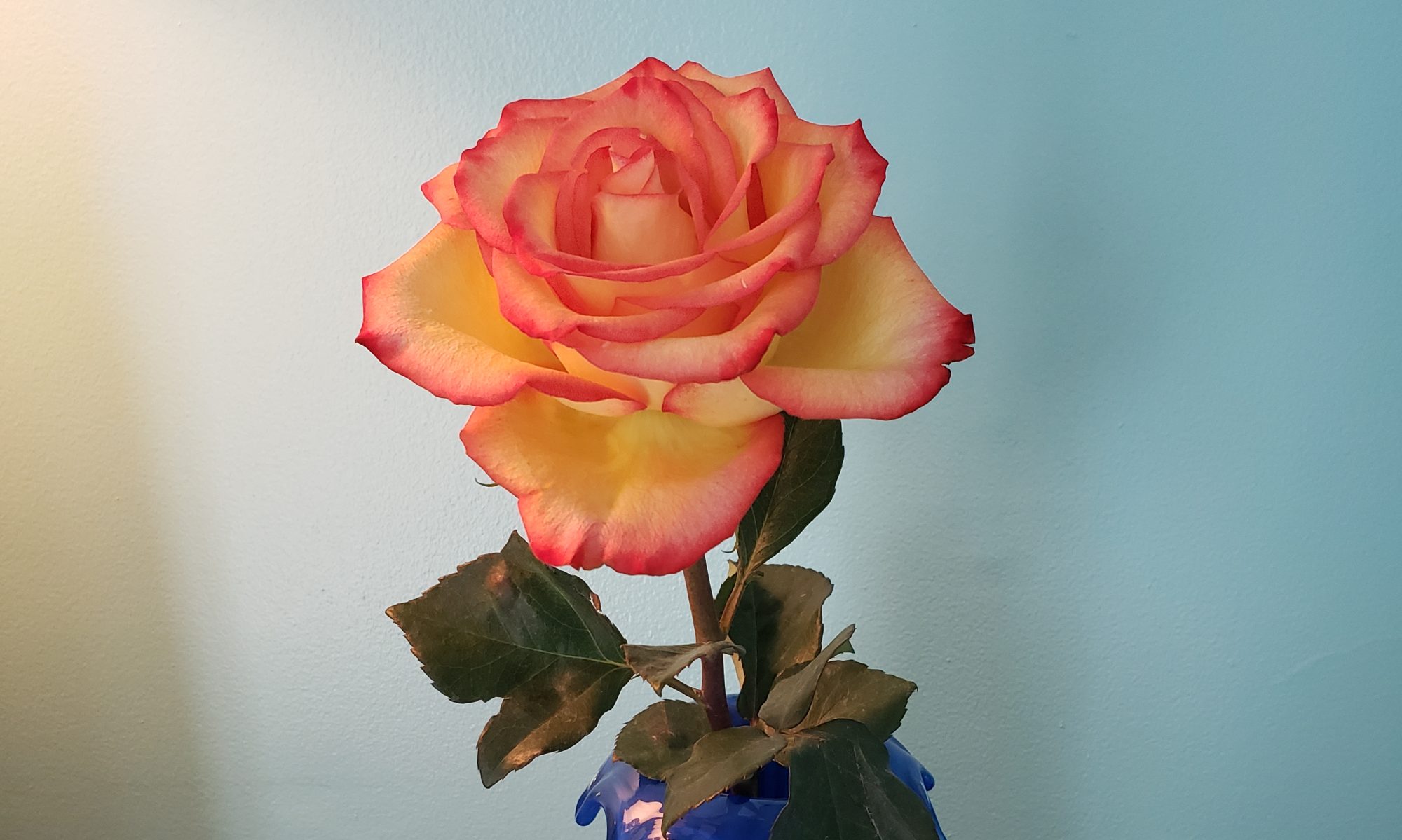
Today I was thinking about how my favorite roses are the ones that look like this. I have one as the background of this website, in fact.

Yellow, but with a goodly amount of red as well.

A yellow rose is for friendship.

This, to me, is the ideal relationship structure.


A close friend made this quiz for thinking about your relationship, as part of his work as a therapist. It can either be for analyzing an existing relationship, or for thinking about what your ideal relationship would look like. Anyway, I think it would work pretty well to visualize it with different rose colors, or with a full-om Tussie Mussie.

https://quiz.sowellsocialwork.org/lovetrianglequiz

A new silly astrology question

Instagram apparently knows I love corporate astrology! I got recommended this video, about asking your partner if they’re a fairy, a witch, a princess, or a mermaid.

I can’t remember which is which and my Instagram timer has run out for the day, but I think I’d say “witch.”

https://www.instagram.com/reel/DK8Ec4PSYFm/

Which one are you? And what do you think it says about yourself?

(Don’t bring this to your next office mixer though.)

A difference: basic social interaction

Today I saw this Instagram video and the comment section just made my head explode.

https://www.instagram.com/reel/DJTXEX7OsMq/

Person A: Oh, I love your tattoos!

Person B: Uhhhh, okay?

Person A: …Actually, they’re UGLY!


So, obviously, I would never go straight to that third line there. But I believe very strongly that Person B’s response is rude, and not in line with appropriate social behavior in public.

We are all humans together in this world. As the meme goes, we live in a society. And like the concept of small talk, small interactions like this are the grease in the gears that helps make everything better and more smooth.

Carolyn Hax recently called the opposite behavior (like saying “uhh, okay” to a compliment) “a lye bath in the gears” (because it strips out the grease, and I think that’s an apt description.

Of course you don’t “owe” anyone anything. Technically, no one owes anyone anything ever unless explicitly agreed to. But I, for one, do not want to live in that shitty Ayn Rand-esque universe of Emotional Libertarianism. I want there to be a baseline level of connection and communication with my fellow humans, out there in society.

So. For your “how to human” script, here is how a good interaction goes:

Person A: Hey, I really like your tattoos/hair/T-shirt! (Nothing about their body shape or body parts. Hair does not count as a body part.)

Person B: Thank you!

That’s it. That’s the script. After this interaction, they both go on about their day. It is not appropriate, as strangers, to try to force a more intimate interaction; but this much is fine and appropriate.
Board games: vibes vs mechanics

Yesterday, I went to a local board game store’s big yard sale event, and had some random conversations with people. After mistakenly trying to pick up one guy’s Mystic Vale because I thought it was still unclaimed (he was just resting his arms ๐Ÿ˜‚ that box was big!), he pointed me to a game with similar mechanics, but a space theme instead of a fantasy theme.

I said “Thanks, I appreciate it, but I usually go for vibes over mechanics” and he nodded like he understood exactly what I meant.

Because here’s the thing: I do enjoy different types of game mechanics! Some more than others. In my board game group, I’m infamous for disliking trick takers, for example.

But the thing that makes me LOVE a game isn’t the mechanics. I enjoy Arcs, and will willingly play it with my friends, but I actively seek out Root games (when I have a spare full afternoon, which is, granted, not that often).

But sci fi games aren’t what fill my shelves. Cozy fantasy or nature theming is more my jam.

This feels similar to how my friend group somehow settled on only ever playing Century Golem, even though Century Spice Road is an identical game. There’s just something cooler about mining magical gemstones to power ancient guardians than there is about becoming a really good merchant. (Although I’ll always play a game or two of Jaipur!)

So. Vibes vs Mechanics. Which one are you?

Internal vs External Processing

This Instagram reel highlighted a difference I haven’t been able to put into words before: Internal vs External Processing.

I know I process things by talking them out. I used to joke that I have an “external dialogue” rather than an internal monologue. But not everyone works that way.

Like the commenter said: this is one of those Differences that should be brought up in couples therapy and premarital counseling. Figuring this kind of thing out first can make solving the other problems exponentially easier.