Value vs Value

A letter writer in this week’s Hax chat drove me absolutely bananas.

She writes that “our work is equally valuable” – but she doesn’t indicate that she understands the multiple Senses of the word “value.”

Not all work is Remunerative.

Not all work is Emotionally Fulfilling.

These two things are orthogonal to one another. A job that puts a roof over your family’s head is Valuable-like-Remunerative. A job or hobby that makes you happy is Valuable-like-Fulfilling.

The LW needs to understand that she has an obligation to ensure that her children do not go homeless. That doesn’t make her hobby work any less Fulfilling or whatever, but it does mean that the fact that her hobby work is not Remunerative is a HUGE FUCKING ISSUE.


Here’s the text. I’ll go get the full link in a bit.

The end of our beautiful work paradigm
Guest
12:55 p.m.


Dear Carolyn,

My husband and I have always had an understanding that our work is equally valuable, even though his work is more traditional and brings in consistent benefits/salary, while mine is a balance of occasional freelance work that pays and artistic passion projects that usually don’t pay (some years actually costs us money). Getting to the place where we are mutually respectful of each other’s work took years and some therapy to achieve, but until recently we are in agreement that I am just as entitled to dedicate energy to my work as he is to his. (This would come up, for example, in balancing childcare and housework responsibilities—I get equal time to work even if the money it brings in isn’t equal.)

The problem is that with the looming federal overhaul, my husband’s work is more important and more vulnerable than ever. We’re okay for now, but we had a Come to Jesus talk the other day where he suggested (and I agreed) that there may be a point where we have to live on savings. If that happens, he says, we will need to both prioritize paid work, and we will both have to do whatever is possible to keep him employed (even if it means I no longer get my equal time).

As much as I understand why this has to be, my whole soul jumps up in rage against it. Carving out my weekly work hours was such a hard-won victory and one I feel defensive of with everyone outside my home, and now I have to go back to fighting for it with my husband too? His answer to that is “But we have to pay the mortgage.” Yes, but this was a beautiful phase and I am so angry that it’s ending. Any advice?

Carolyn Hax
Advice Columnist
You’re entitled to your anger, certainly. But you’re not entitled to dump it on the wrong person just because this is your personal third rail.

If I read you correctly, any compression to your time window for your work — if it happens — will come from forces outside your marriage. So get angry at them, not your husband.

Then find some healthy outlet for your anger so it doesn’t harm you and your husband through corrosion — which isn’t overtly wrong the way blaming him for his job vulnerability would be, but is an insidious problem that’s within your power to address.

This is all “if”; maybe the chaos fairy leaves you alone.

But related to this: The hard work you did to create and defend this arrangement can make protecting it your emotional default even when your husband’s mental health is the valid priority. If you can’t trust him, yourself and the foundation of your arrangement — enough to leave it “unguarded” while you prioritize him through (literally) newsmaking stress and turmoil — then that could create much bigger problems than whether you preserve the structure of your deal.

A deal that, I do want to note, grants 50-50 value to each of your work when yours apparently gives you passion/soul satisfaction and his carries the family. Any soul/passion payoff in it for him? Okay for me to assume not?

Either way, just on the money front: While I cheer the idea of granting equal value to work for the sake of work and not just for what it pays, it does seem as if your husband took on extra mental load in this deal financially.

While you’re waiting to see what happens and still just talking about this, you can — calmly — make it clear that you want any adjustments to be responsive to the moment only and not a permanent ceding of ground that has been so meaningful to you. Or, if you trust him to knwo this already, say out loud that you trust him. But I would save all that for after you convey to him that you will, of course, not leave him to carry ALL the worries of how the family’s bills will get paid if the chaos fairy does visit him.

Right? You will, if it comes to that, do whatever your family needs?
Social Time and Normative Time

Despite the fact that I have a lot of trouble being on time to things (probably due to a little bit of time blindness/optimism about how long it’ll take to do stuff), I have a very Normative sense of time: things happen at an established time, and we should attempt to meet that time/deadline to the best of our ability.

My friend told me a while back about another way of viewing time – Social Time. This is the way of thinking about time that’s often assigned a nationality (Moroccan time, Greek time, Island time, whatever), and it’s associated with just accepting that things happen when they happen and not stressing too much about running later than anticipated.

I find Social Time very anxiety inducing; this might be related to the Ask/Guess dichotomy, in that I like to have things clearly defined (even if I fail to meet them). Hard to say for sure.

I also have this Tweet bookmarked from a while ago; let’s see if embeds still work.

https://twitter.com/the_wilderless/status/1578258844605730816?s=20&t=BfpB_R4f5-Hz_SEOHkNY_w

A dichotomy in financial advice

Something that crystallized recently, for me, is that financial advice from friends seems to come in two basic shapes:

  • “Should you really be spending money on that right now?”
  • “Have you put a line item in your budget for that?”

I used to be more the first; but now, I’m striving to aim for the second. It’s less judgemental and more accepting of the fact that not all of us have the same financial priorities, and that’s okay.

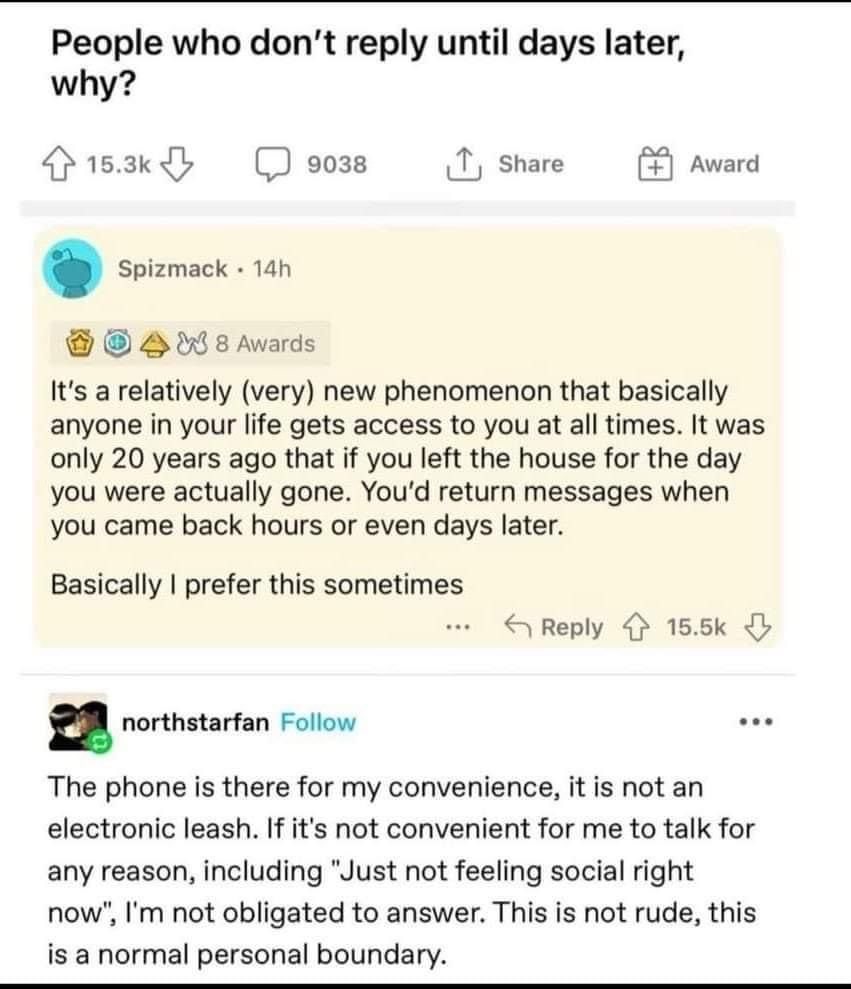
Differences: phone on silent or no?

A dichotomy I’ve noticed a ton over the years is the different ways people handle their phones at night (or when they sleep).

Some people keep their notifications turned on, and expect their friends not to send them text messages (the way, in the olden days, we didn’t call on the POTS phone after 9 pm because it was inconsiderate).

Other people set their phones on silent or Do Not Disturb at night, and simply check their messages in the morning.

I’m a part of Camp 2. I generally lose touch with Camp 1, because I’m never sure if it’s okay to text them or not.

In general, I treat texting as asynchronous. If something is urgent, I make a phone call (or other workaround if the person does not use the phone).

I don’t think it’s reasonable to expect someone to wake up to text message notifications. That level of sleep interruption is unhealthy (not to mention literally torture). Similarly, I don’t think it’s reasonable to expect someone to *not* send a text message when the thought strikes them; texting as a medium is very different from speaking (in person or on the phone). Again, it’s wholly asynchronous.

I’m aware that this probably makes me a Very Geriatric Millennial or whatever. Now get off my lawn.

In any case: like most Differences, this is something that folks hold in a very deep-seated way, where you’re unlikely to change the other person’s mind; all you can do is acknowledge the way they feel, and do your best to get along. Which is really disappointing, I know.


Or: see this Tumblr screenshot (transcript to follow) expressing basically the same idea.

A very basic Difference in people: Shoes in House

One of the first “huh, this is a significant cultural difference” things I ever noticed was the idea of “Do you wear shoes in the house?” (With the connotations of “outdoor shoes” there. Some folks need to wear orthotics or other things for physical support while walking, but that’s separate from this question.)

I don’t exactly recall if I took my shoes off as a child. I’m pretty sure I did, if only because my bedroom had carpet, but I know my parents leave their shoes on (if they’re clean), so I don’t think I was raised to. It just made sense. (Also, my shoes were more likely to be muddy than theirs; they had specific work shoes for the yard and stuff in the basement, while I didn’t have a bunch of Old Shoes lying around because I grew out of them so fast.)

But as an adult who is now a No Shoes In House person, it’s been interesting navigating this with other people. I haven’t had any problems with “Would you be okay with taking off your shoes?”, I think because it’s polite and allows the wiggle room of the other person to say “oh, actually I need them for support.”

I think if I had a stronger disgust response to Shoes In House, I’d probably buy some disposable booties for folks to wear when they were over. But as it stands I’m okay with people in the living room with shoes on, and I just vacuum up the dirt when they leave.

But all this idea has now got me wondering if there are other cultural differences that I’m just not aware of. Like, I saw a TikTok once that was like “I don’t wear outside pants on the bed.” And my first reaction was, oh, that’s ridiculous. But if I’ve been someplace with a lot of strangers, like traveling or something, yeah I’ll take my pants off (and sometimes put on others) before I sit down on the bed. (Or I’ll pull up the quilt so the cooties don’t go where I’m sleeping.)

So yeah. What other imperceptible cleanliness rituals do I have that I’m just not conscious of?

Explorer vs Exploiter

A few years ago, I remember reading an essay about a personality dichotomy that the author called Explorer/Exploiter.

The idea is that most people fall into one of these two categories (though of course humans are complex, and it’s never just that simple).

An Explorer is someone who tries new things to see if they like them. Trying new things makes them feel excited and good.

An Exploiter is someone who finds the thing they like, then sticks with it.

You might see this, for example, with restaurants. I often find myself going back to my old standbys, rather than trying new places, because I know what’s good at the places I already like.

But I’m trying, lately, to get out and try new things. There’s nothing wrong with having favorites! But I don’t want to miss something else that I might like even more, too.


A similar concept came up in a Carolyn Hax column at some point: a person wrote in and referred to “If you’re not growing, you’re dying.” And I take STRONG issue with that framing. In my mind, if you don’t stop growing, you’re a cancer.

There’s nothing wrong with healthy growth. But growth does not need to be constant and unending, either. It’s okay to have dormant periods. It’s okay to just do things you like, because you’re good at them. (I also have this soapbox about jobs. I hate the idea that it’s “stagnation” just because you’re in the same position for a little while.)

Fun Vacation, Relaxing Vacation, or Traveling With Children

A few years before I had my kid, I came up with (or possibly read about? It’s been a minute) a fundamental difference in vacation philosophy: do you go on vacation to Relax, or do you go on vacation to Do Fun Activities?

Neither kind of vacation is right or wrong, mind! They’re just different styles of enjoying yourself. I think this is somewhat related to, or at least similar to, extroversion versus introversion. Some people prefer to always be on the move, and some need down time to recharge.

If you’re planning a vacation with someone new/for the first time, you’re definitely going to want to discuss with them which kind of vacation they prefer. You should also factor in the location and cost when making that decision; for example, I would consider it a huge waste of money and travel spoons (and carbon expenditure, let’s be real) to fly to Japan only to have a Relaxing Vacation. If I’m going to another country, it’s because I specifically want to go there and do things there.

When you throw a kid into the mix, things get even more murky. Being a parent of a small child is like traveling around with a small robot that has self-destruction wired into its circuits. You cannot relax if you have a young child with you, unless there are other competent adults along for the trip.

This lack of ability to relax is called “Traveling With Children.” And it is not, ever, a “Vacation.” If you’re lucky, you can have small Fun Activity vacation slices within it, though!

We stopped going to the beach with friends because the house they rented every year had a pool, and we didn’t trust the entire complement of 6-10 childfree 20-somethings to always remember to shut the gate. (You don’t fuck around with pools. You just do not. They’re like guns in terms of danger to children, only they’re quieter and more appealing.)

We did take her to the beach for a family wedding, and we stayed in a house with a pool because we knew we could trust the grandparents (who were also in the house with us) to be diligent. They also gave us respite childcare so we could relax a little bit on the trip. But that was still mostly just a Traveling With Children trip, because we had no “relax” default mode. We were still “on” for 90% of the time.

If you have relatives who try to pressure you into going on Big Family Trips, you’re not a bad person if you can’t stomach the idea of trying to keep you tiny human alive in a strange place with no routine and no comforts of home. I’m profoundly grateful that my family helped us with caring for our child on those trips. But I’m also very aware that not every family is like that.

So, that’s my feelings about Relaxing Vacations, Fun Activity Vacations, and Traveling With Children.


This Onion article gives a pretty devastating take on Traveling With Children as well: Mom Spends Beach Vacation Assuming All Household Duties In Closer Proximity To Ocean

Chaos Muppets and Order Muppets

I recently had the delight of discovering this dichotomy in humans: are you a Chaos Muppet or an Order Muppet, and are you yoked to someone like you or someone different from you?

I first heard of it in this Reddit post: https://www.reddit.com/r/AskWomenOver30/comments/zivdeq/does_your_partner_do_this_not_sure_what_to_call_it/?utm_source=share&utm_medium=android_app&utm_name=androidcss&utm_term=1&utm_content=share_button


And here’s the original essay on Slate: https://slate.com/human-interest/2012/06/chaos-theory.html

My toxic trait (as the kids these days say) is that I’m a chaos Muppet who aspires to be an order Muppet. This can sometimes lead to tears.


Frog is an Order Muppet; Toad is a Chaos Muppet.