So, I had appendicitis last weekend! Be warned, this gets gross!
Continue reading “Appendicitis processing”The Last Rose of the Season
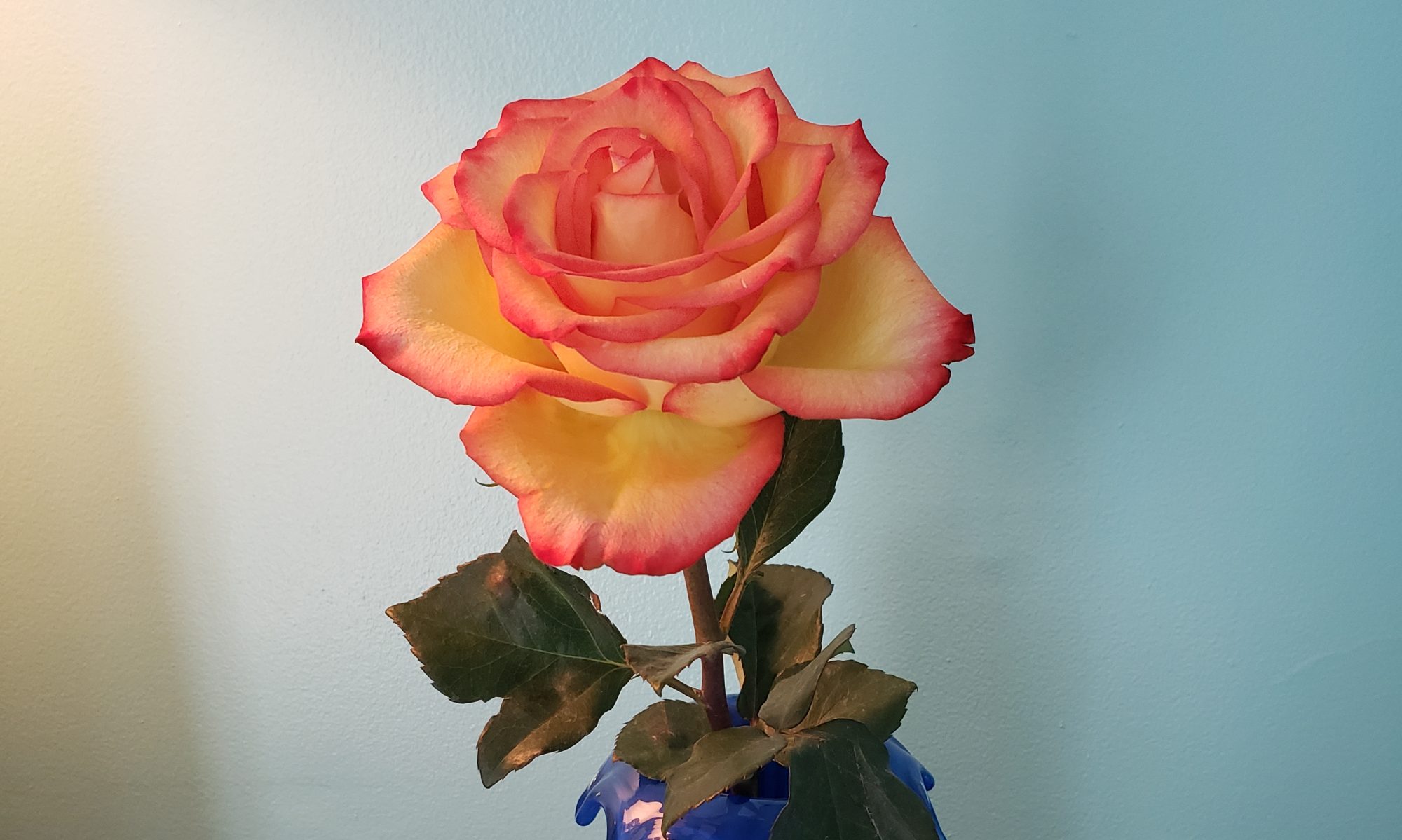
I have some knockout rose plants by my house. They’re not fancy, just cheap hybrids, but every year they produce beautiful flowers for me.
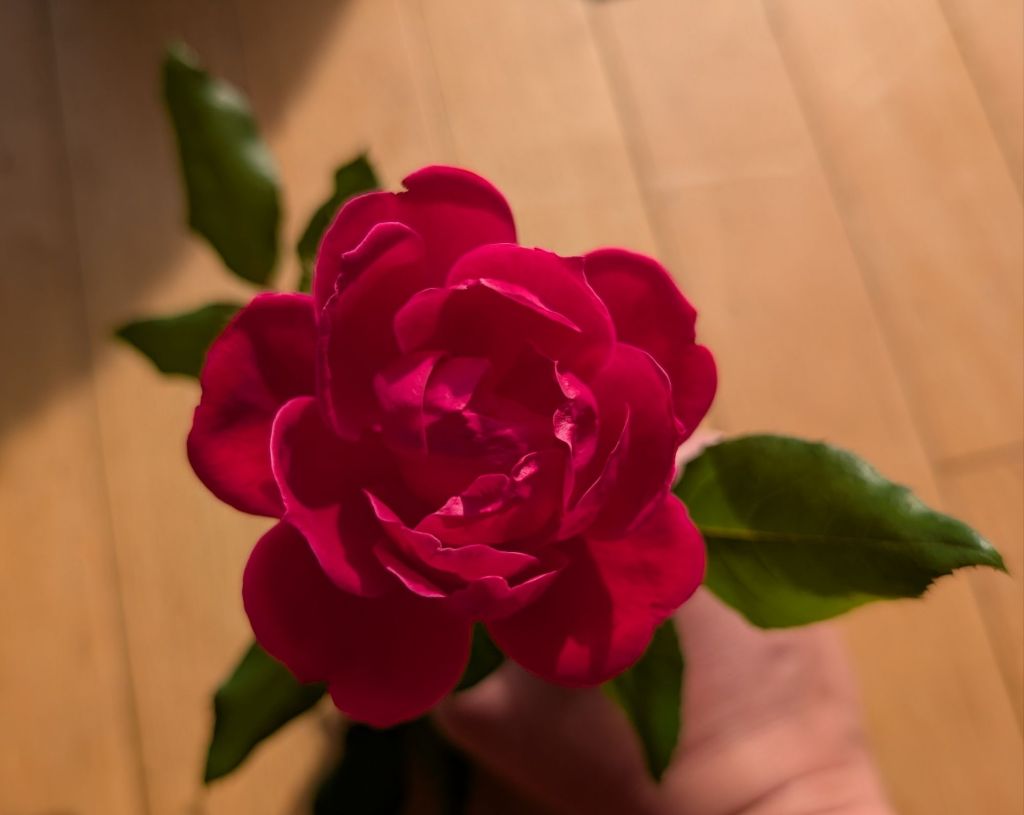
This year, in November, when everything was going dormant. the one closest to my door suddenly decided to produce a flower. I made a big deal about it – roses in November, The Last Rose of the Season, etc. I picked it and put it in a vase, and when it began to wilt I hung it up on the wall to dry.
Then, the rosebush made ANOTHER flower in December. It’s wilting right now in the front bed, in the most perfect “seven for beauty that blossoms and dies” dramatic pose.
And what I am taking from this is: There is no guaranteed Last Rose of the Season. Even something that you might think is final, is the end of all things, might not turn out to be.
And yes, it’s important to cherish those Maybe Lasts. When my daughter was in preschool, I thought often about “is this the last time I’ll be able to pick her up?” Children grow. I’m not a power lifter. There was, indeed, a last time.
But we never know exactly which one will be the Last. So cherish those moments; but never give up hope just because you think it’s the end.
I know this is contradictory, but contradictions are just the nature of the world, like roses in December.
(I’ve written and deleted about five paragraphs’ worth of Discourse about whether “nature” includes manmade things, and then I decided: let’s not. This is “nature” in the sense of “reality,” not in the sense of “a human didn’t influence this.” Humans are part of nature.)
Anyway. My point in all this is: Keep hope alive. Don’t give in to the despair. Allow the world to surprise you, and to be wacky and obstinate and uncaring about social or horticultural norms.
There is no Last Rose. There is always another.
Bonus! Songs featuring roses!
- Tam Lin
- Goodbye to the Roses
- Barbara Allen (although this is not the version I just heard! I’ll have to go find that one)
- Demeter’s Daughter (Grace Griffith)
Hearing loss simulation
Today I learned about this Flintstones video, which simulates the effects of hearing loss, and its perfect.
This isn’t precisely the way mine sounds, but it’s close. I’ve described it as being muffled in the way snow can muffle sounds before.
Stardew conversation
“I wish I could take my horse on the minecart.”
“What?”
“You know, the mine carts! I want the horse to get to take a break.”
“The horse wouldn’t fit on the mine cart.”
“I think it would!”
“I think you need your horse privileges revoked.”
Which of us is 12 and which is 42? 😂
Grief
I am missing my friend who passed in 2023 today. She was a support to me during my divorce, and I guess it’s that season again.
To old friends, absent lovers, and the Season of Mists.
Aging dummy thicc
I’ve been mulling over the word “thick” or “thicc” lately. Like a lot of slang, I’m pretty sure it originated in Black English, and is generally seen as a compliment. But when I think about who it’s applied to, I think it’s generally just specific body types that are thicc (fat in an acceptable way), in the most common usage of the word.
As I’ve been getting older, most of my weight gain has been centered on my belly. Sometimes folks still ask if I’m expecting. It’s stopped hurting, but it’s always jarring.
But I think about that, about the fact that I have a thick waist/belly and no noticeable hips or butt and minimal (though finally, beautifully, extant) boobs; and I think of the phrase “unfashionably thick.”
But then I think more about that phrase. It’s the sort of thing you might see in a fantasy novel that has a female protagonist: where “unfashionably thick” is just code for “she’s conventionally attractive in our world, but not in her own.” And I think the word for my middle aged wine mom lib body is “thick, in the unfashionable way.”
But it is still mine; and I am grateful to have it.
Gender update: Luz edition
I wore the following outfit to a friend’s wedding in April of 2019. Little did I know that one year later, Owl House would replicate it on Luz for Grom Nite!
Continue reading “Gender update: Luz edition”Unexpected joys
You know, there’s a lot of discourse right now about Facebook and how ugly everything is and the Dead Internet and all of that.
And I definitely feel the pull to leave all the social media tools and stick to nothing but this geocities upgrade I find myself on right now. But I still stay on Facebook, because I genuinely *like* keeping in touch with people from high school.
And then today, one of them sends me this in the mail.
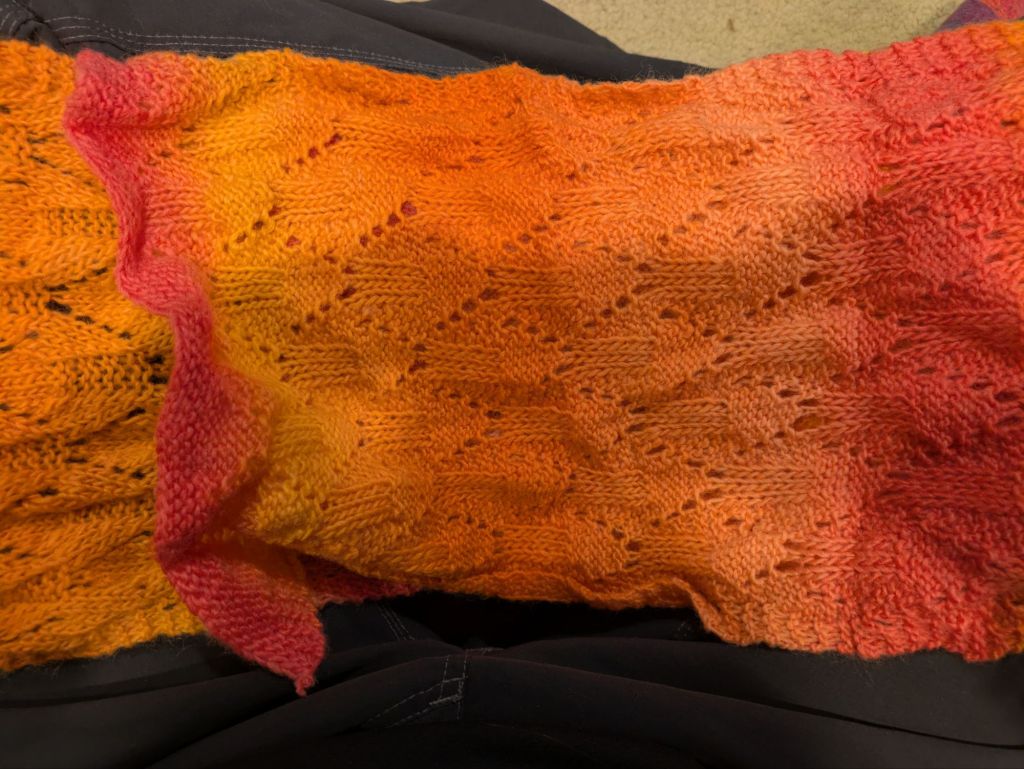
The most beautiful flame-colored scarf.
This is why I don’t leave. The people in my life make me who I am. And I’ll be sending them Christmas cards long after Facebook is consigned to the dust-heap of history; but I’m grateful to the thing Facebook briefly was, that let us get back in touch with each other.
On groups and dyads
A variety of painful circumstances in my life recently have crystallized out a thought, for me: as much as we want a Group to be a cohesive unit, the group is only as strong as the strength of its various dyadic friendships.
When a group that had been constructed around one central Hub Person implodes, the continuance of the group is dependent on whether any of the Spoke People had actually formed individual (“dyadic”) friendships with each other. Without those interconnected friendships, the group would wither away without its Hub. (And maybe that’s why some Hubs feel threatened when they’re no longer the gatekeepers of access to the other friends?)
And when a large enough group (40 or so people) forms, not everyone will be as close to everyone else in that group; so it’s up to the individuals to build (or not build) their friendships with one another. If one person is having a crisis and reaches out, I am finding that sometimes, a larger group is *less* likely to respond. It’s the small six person chats that get things done for each other; or it’s an existing dyadic friendship within the larger circle that recognizes the need and answers it.
Is this the Bystander Effect in action? Are the larger groups prone to feeling too helpless to help? Someone else will do it?
Is this an effect of geography? Some of my Discords are pretty geographically dispersed, and I think that makes it harder (though not impossible) to build those sturdier connections.
It can also be hard to know what/how someone needs help. With closer individual bonds, there’s more of a chance that the person helping will actually help, versus accidentally making things worse. (I know that’s a thing for me as well: I’ve made things worse so often.)
But I just had an absolutely terrible week, and all kinds of people came to my rescue; and I am so grateful. And I witnessed someone else leave a group because they weren’t getting the support they needed, and my heart aches for them; but we were never directly close with each other, either, so I felt too distant (geographically and emotionally) to help. So it goes.
But anyway, my point in all this rambling is: If you are in a large friend group, make sure you aren’t neglecting the individual connections with individual people. In the end, “The Group” is a legal fiction. The people that help you move are the real individual humans that you can bond with, or not, as life takes you.
But try to take care of each other. Yes, The Village is built on unpaid labor. It’s transactional even though it’s not tracked, or shouldn’t be tracked, because Village Support is about having help with specific concrete actions that need doing.
I don’t know. I’m rambling and tired. But just. Look for the helpers; and be the helpers, when you can.
‘Til we’re on the other side
Today I was listening to “The Breaking Light” by Vienna Teng, and remembering a friend’s pregnancy, and how we were all holding our breaths for her.
Listen to the sirens, listen to the heartbeat
Listen to the turning tide
Listen to the murmurs, carry them inside you
‘til we’re on the other side
And we listened to the heartbeat. And now we’re on the other side, and she has a rambunctious toddler, and we all breathe.
And I think this is a good time of year, and time of history, to remember that there will always be another side. We’ll get there and we’ll get there together.
 Emilybook