
Your generation would probably live-tweet the Apocalypse

Many years ago, I came across this poem on the Internet, by Tumblr user hersassyfras. They deleted the original post; but thanks to the magic of Tumblr, the text got reblogged a bunch of times, so it’s still around.

Here it is today.


“Your generation would probably ‘livetweet’ the apocalypse” you say, and you laugh
You mean it as an insult, and I understand,
Or you don’t
because the word lies awkwardly on you tongue, stumbles as it leaves your lips, air quotes visible
You meant it as an insult, so you don’t understand, when I look into your eyes and say “Yes”
Because we would.
It would be our duty, as citizens on this earth
to document it’s end the best way we know
and if that means a second by second update
of the world going up in flames, or down in rain, or crushed under the feet of invading monsters
so be it.
It would mean a second by second update of
“I love you”
“I’m scared”
“Are you all right?”
“Stay close”
“Be brave”
It would mean a second by second update of the humanity’s connection with one another,
Proof of empathy, love, and friendship between people who may have never met in the flesh.
So don’t throw the word ‘Livetweet’ at me like a dagger, meant to tear at my ‘teenage superiority’
Because if the citizens of Pompeii, before they were consumed by fire,
had a chance to tell their friends and family throughout Rome
“I love you”
“I’m scared”
“Don’t forget me”
Don’t you think they’d have taken the chance?
Family politics: education funds

If you are the parent of a young child, and a family member offers to pay for their education, you thank them politely and then conduct your planning as though they are contributing $0.

Exception #1: if they show you the statements every year and have a coherent plan for how they will conduct themselves if the child does not conform to their expectations of behavior, how this savings account interacts with the Medicaid clawback period, etc. Then you can safely count on the dollar value you see.

Exception #2: they write you a check for you to deposit into the child’s 529 plan.


Note that you can start saving for a future child’s education before that child exists, in most states. Create a 529 investment account with yourself as both Owner and Beneficiary; then, when the child is born, transfer Beneficiary to the child. You remain the Owner.


If you are a grandparent who plans to contribute to a child’s education, you need to first research the cost of a college education in the state where your grandchild resides. I had a friend whose in-law did the thing in the first section here, and it turned out they had saved exactly $500. Her child (expected to graduate in 2031) will probably have college costs three orders of magnitude greater than that.

You do not have an obligation to cover the entirety of anyone’s education, of course. But we are grandparents of action; lies do not become us. A lot of people in my parents’ generation seemingly think that college still costs $250 a semester despite what they paid for OUR education.


If you are the parent of a high-school aged child who is looking at colleges, you need to be explicitly clear with them about what you can and cannot afford to contribute to their education. Morally speaking, you also owe them help with filling out the FAFSA. I’ve heard enough horror stories of people whose parents refused to “give the government that information” (IRS notwithstanding) and denied their children any opportunity at grants or scholarships.

I still remember a high school friend whose parents just didn’t tell her how much they could afford, allowed her to get her heart set on a private college in the northeast, and then told her they could only afford in-state and she’d have to make up the rest in loans. She was extremely sad to have to give up her first choice school, even though she absolutely made the right decision in going to an in-state public school rather than taking out loans. Her parents should have been realistic from the start. If you are a parent in this situation: swallow your pride and be honest and clear with your child.

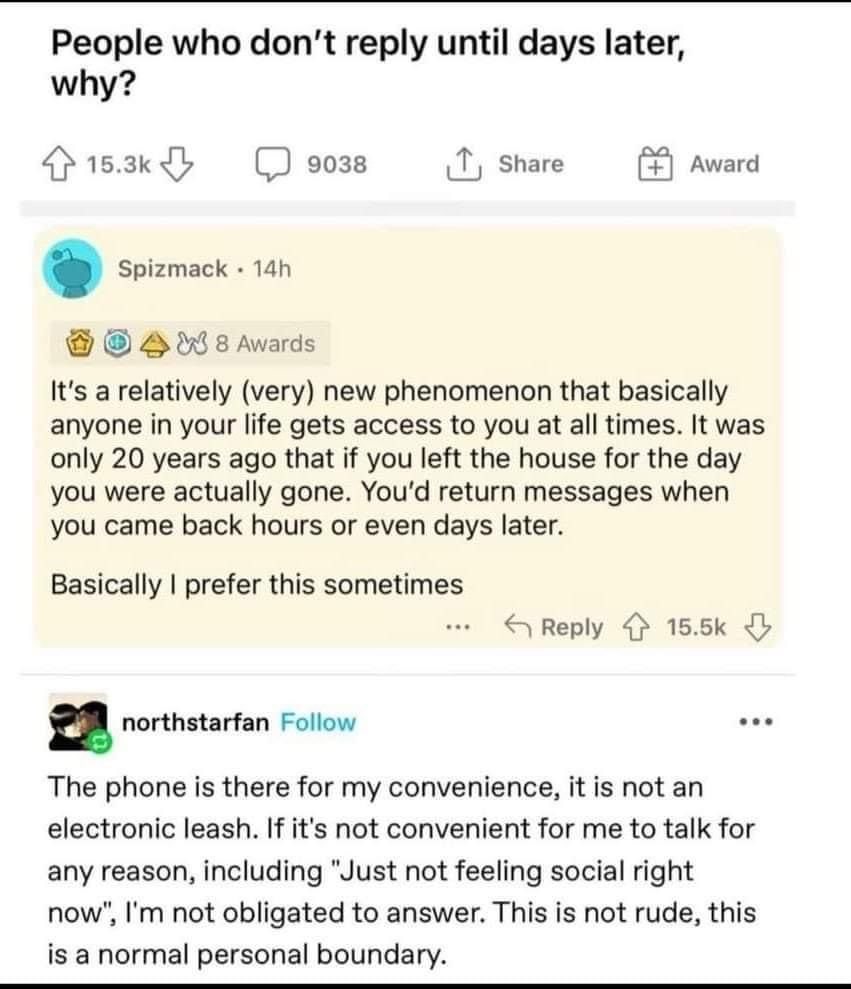
Differences: phone on silent or no?

A dichotomy I’ve noticed a ton over the years is the different ways people handle their phones at night (or when they sleep).

Some people keep their notifications turned on, and expect their friends not to send them text messages (the way, in the olden days, we didn’t call on the POTS phone after 9 pm because it was inconsiderate).

Other people set their phones on silent or Do Not Disturb at night, and simply check their messages in the morning.

I’m a part of Camp 2. I generally lose touch with Camp 1, because I’m never sure if it’s okay to text them or not.

In general, I treat texting as asynchronous. If something is urgent, I make a phone call (or other workaround if the person does not use the phone).

I don’t think it’s reasonable to expect someone to wake up to text message notifications. That level of sleep interruption is unhealthy (not to mention literally torture). Similarly, I don’t think it’s reasonable to expect someone to *not* send a text message when the thought strikes them; texting as a medium is very different from speaking (in person or on the phone). Again, it’s wholly asynchronous.

I’m aware that this probably makes me a Very Geriatric Millennial or whatever. Now get off my lawn.

In any case: like most Differences, this is something that folks hold in a very deep-seated way, where you’re unlikely to change the other person’s mind; all you can do is acknowledge the way they feel, and do your best to get along. Which is really disappointing, I know.


Or: see this Tumblr screenshot (transcript to follow) expressing basically the same idea.