I like this.
https://hennymarlene.substack.com/p/you-should-pick-your-friends-up-from
Do the thing.
Be inconvenienced.
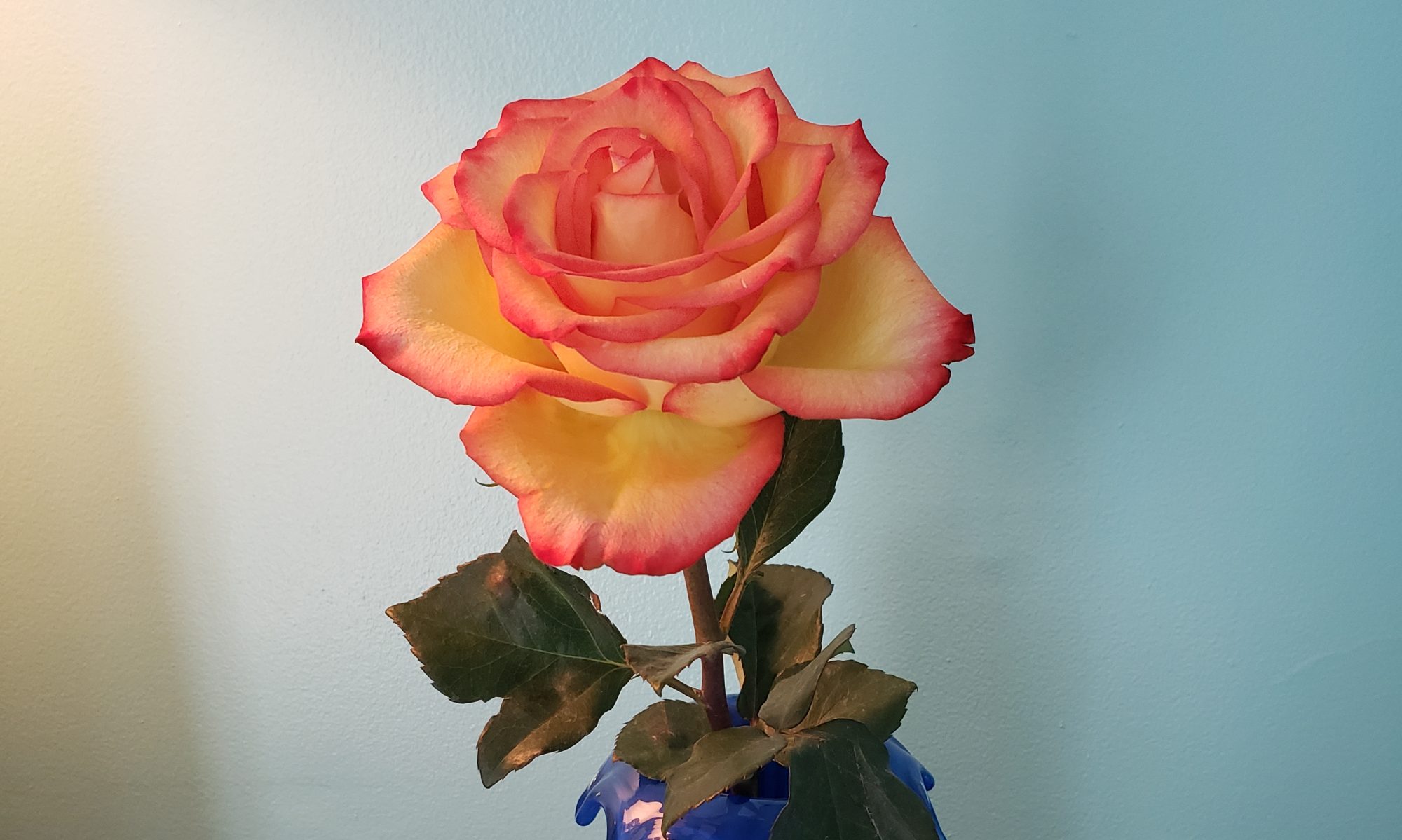
Ten pounds of personality in a five-pound bag
I like this.
https://hennymarlene.substack.com/p/you-should-pick-your-friends-up-from
Do the thing.
Be inconvenienced.
Several years ago, a friend introduced me to the concept of “Social Time vs Normative Time.”
“Normative Time” is the idea that things happen at certain times: dinner is at 6, the meetup officially starts at 5, things like that. It’s generally considered to be the default time system in America.
“Social Time” is something that I’ve more often seen in the context of specific places: Moroccan Time, Island Time, Greek Time. Time is more fluid; you get there when you get there; you don’t stress if you’re late or your friend is late.
I, myself, am a Normative Time person who is very bad at it.
Today I was reminded of the Captain Awkward column on Perpetual Time Optimism because Reddit shared it with me. It gets a bit spicy in there (in both).
In general, in my life, I try to strike a balance between both types of time. I’m sympathetic to the time blind people; I’m often late to things, and it takes me a LOT of effort to do all the things to get to something early, especially if it’s already early in the morning. But I also want to be able to do things like “see a movie” and “eat at a restaurant” and so forth! So in general I try not to invite the very time blind person to things where “being late” would put a cramp in someone ELSE’S day.
I think this is a really good explanation of why it’s important to not assume what other people are thinking.
https://www.instagram.com/reel/DL9yBL_NJzc/
I used to have a friend who would get SO CONVINCED that other people hated her, based on various indicators. As an outsider to her interactions, my perspective would generally range from “hmm, I don’t think they actually thought anything about you at all” to “I think they were actually sympathetic” to “they’re just in a bad mood, but that doesn’t mean they hate you.”
It’s much better and less exhausting to not assume everyone hates you.
I need to save this for every time some person is like “waaah they crossed my boundaries” and then does nothing about it.
https://www.instagram.com/p/DL7TYCpsEDe/
Today I had a small epiphany: throughout the course of my life, I have had men and boys tell me that they wished chivalry was still around, so that they would know how to talk to women and girls/structure their interactions appropriately.
…Those guys were probably just on the autism spectrum.
Gonna chew on that for a little bit.
Anyway, a bonus How To People that I observed in a conversation today: if you are talking with someone (perhaps while walking towards the parking lot together) and the conversation dies down, it is okay to say “Well, good chatting with you, talk to you later!” and just wander off/speed up your pace/slow down. This is an accepted script for How To End A Conversation.
I’ve been thinking about the Geek Social Fallacies again, and about Ostracizers Are Evil (fallacy #1).
This Reddit post summarizes it pretty well.
https://www.reddit.com/r/AbuseInterrupted/s/syogLYSwkV
It’s not wrong or evil or Just As Bad As The Bullies to ask someone to leave when they are being obnoxious.
People can, and do, learn and change and grow. But they’ve gotta DO those things.
And neurodivergence isn’t really an excuse; sometimes it’s barely even an explanation. Like they say about trauma: trauma isn’t your fault, but healing is your responsibility .
Lately, I’ve felt very weird asking people how they are doing. Everything is terrible and my. County is one failed court injunction away from breadlines.
So instead of “How are you doing,” I’ve started asking people if they’ve drunk water recently, as a way of expressing that I care about them and want to make sure they’re taking care of themselves too.
And I suddenly realized that I just reinvented the Chinese greeting 吃饭了吗,”have you eaten (rice)?” (Chi fan le ma, pronounced roughly as “chur FAHN luh muh”.)
So. 喝水了吗? Have you drunk water? (“Heuh shway luh muh”.)
Not even gonna try to translate “don’t shrimp,” though.
“You can’t expect the village to show up for you if you are unwilling to be a villager.”
This also gets in a little bit to the concept of RSVPing, and also Ask/Guess culture. It is okay to RSVP “no” to an event! But it’s better to say Yes or No than to just be uncertain; that uncertainty, when multiplied by the number of guests, makes hosting very difficult.
(This is part of why I started doing nuclear hosting of events!)
You know, there’s a lot of discourse right now about Facebook and how ugly everything is and the Dead Internet and all of that.
And I definitely feel the pull to leave all the social media tools and stick to nothing but this geocities upgrade I find myself on right now. But I still stay on Facebook, because I genuinely *like* keeping in touch with people from high school.
And then today, one of them sends me this in the mail.
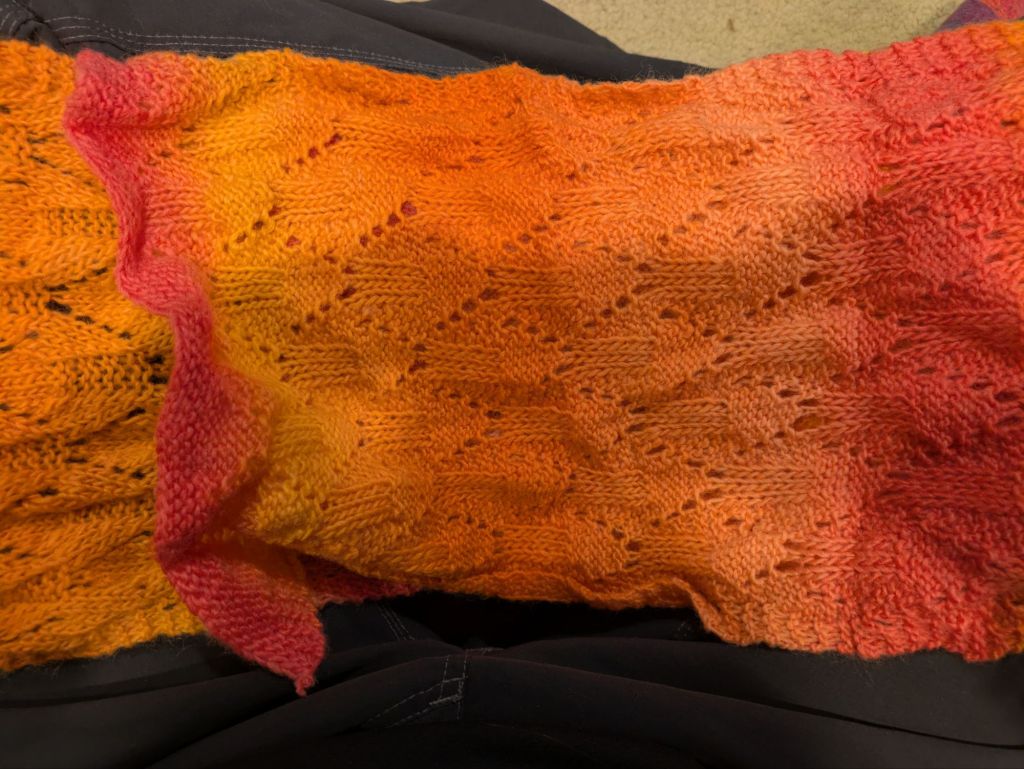
The most beautiful flame-colored scarf.
This is why I don’t leave. The people in my life make me who I am. And I’ll be sending them Christmas cards long after Facebook is consigned to the dust-heap of history; but I’m grateful to the thing Facebook briefly was, that let us get back in touch with each other.
A few years back, I read this essay about “The Most Skipped Step” (when opening up a monogamous relationship).
The post itself is specifically about the context of Non-Monogamy or Polyamory. However, I find it useful even for monogamous contexts, because it’s very important for the members of a couple to retain their autonomy and identity as individuals, even when they are exclusively having sex and romantic relationships with each other and no one else.
Our society prioritizes and elevates sexual and romantic relationships above all else; but our platonic connections with our friends are also important, and can be just as (or more) important than our romantic/sexual ones. If you fall ill, your spouse is likely to be your primary caretaker; but caregiving is hard work, and should never fall on just one person. This is where The Village comes in. And having strong loving friendships is so important for that kind of resilience and endurance.
So, without further ado: the essay!
https://medium.com/@PolyamorySchool/the-most-skipped-step-when-opening-a-relationship-f1f67abbbd49
I have been informed that the author of this essay is Problematic. I do not know the details; I’m just noting this as a reminder that we should read everything with a critical eye and really try to analyze it, not absorb it uncritically. (I expect you all to read my posts critically as well.)
 Emilybook