Trigger warnings: corporal punishment, child abuse.
Continue reading “A very difficult read”Dalmatians and Bassets
One of my friends this weekend said that it’s rough being the parents of a Dalmatian child when your friends have Basset Hound children, because we end up giving them useless advice, like “Why not just have them sit and play video games?” when the kids will not sit still for that.
(This came up when I expressed surprise at a hotel room/suite not being sufficient for a family trip. My child is a quiet Basset Hound.)
The days are long but the years are short
I thought this was a beautiful and powerful art installation.
Unexpected parenting difficulties
Being a dungeon master for ages 12/12/9 is surprisingly difficult. But so far, they seem to be having fun?
They didn’t have enough of an attention span the first session to do a Session Zero, but they’ve given feedback since then so I think it’s probably enough to go on now? Obviously I’m not hitting any really rough emotional stuff, but even things like “combat, talky stuff, or puzzles?” is surprisingly difficult to maneuver.
This session they all got pets (no magical abilities, just cute pets that follow them around and then run away during combat) so that was a big hit!
Definitely open to (written) suggestions for how to (BRIEFLY) discuss Session Zero topics. 😁
(please no podcasts or videos, due to my own hearing and attention issues!)
Enough is, in fact, enough: a meditation on Pieces of Flair
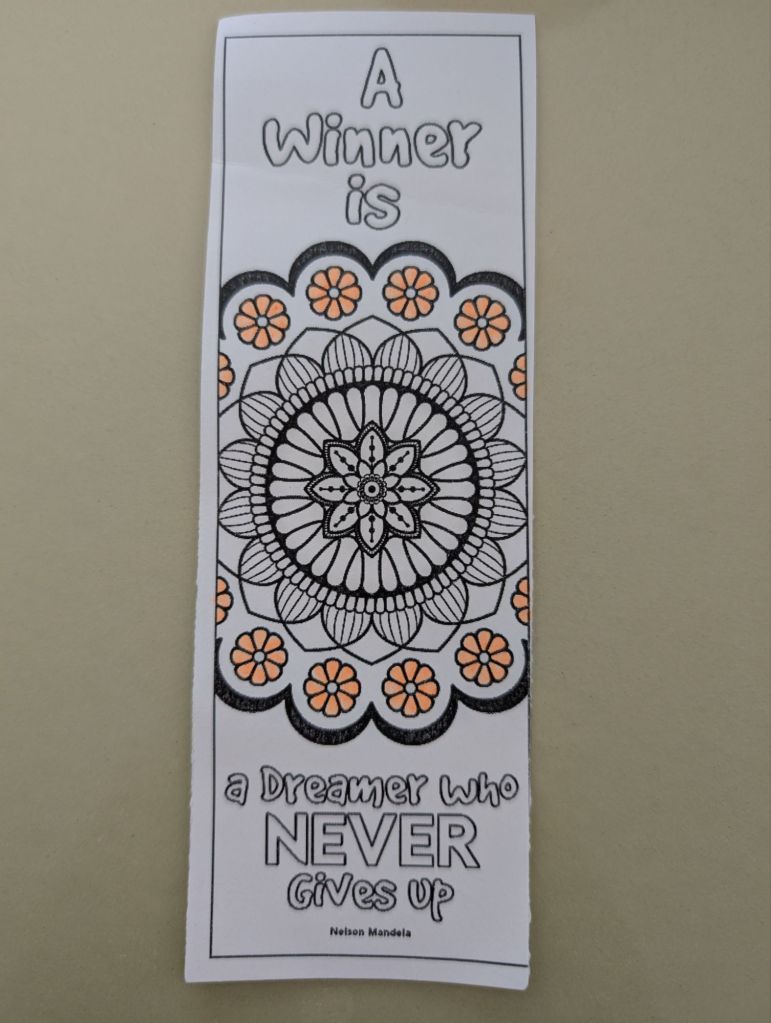
Today I was coloring in a bookmark that had the quippy little motivational message, “A Winner is a Dreamer who Never Gives Up.” — Nelson Mandela
“A Winner is a Dreamer who Never Gives Up.”
Nelson Mandela
And it made me think: is that really accurate? No, it’s not. Or, more to the point: it’s incomplete. A winner is a dreamer that never gave up and also scored better than all of the other dreamers who also never gave up.
But that doesn’t make the non-winner any less worthy of respect and admiration!
I have always hated the old “joke” about “What do you call the guy who graduates last in med school? Doctor!” Frankly, I don’t care what my doctor’s rank in a classroom setting 30 years ago was; I care that they know enough to be a doctor. If this person was actually too stupid to be a doctor, they would not have graduated.
Likewise, and I think we’re better at recognizing this side of things, an Olympian who doesn’t win a medal is still a goddamn Olympian. The person who finishes last in a marathon still ran a goddamn marathon. That’s far more than any of the armchair haters will ever accomplish.
Being told you have to be the best just to be good enough is a stupid (and, frankly, toxic) attitude to take. Do the thing. Do it well. Don’t worry about your relative ranking compared to others.
(Bonus note: this is also what I told my fellow new parents when my daughter was a 99th percentile chonker. Everyone has to be somewhere on the percentile chart, and every percentile has to be filled. It’s just the pigeonhole principle. It’s not a referendum on the quality of your baby.)
The “I don’t like what you like” game
This Instagram video is an amazing example of how to converse with someone who doesn’t share your interests!
If you don’t like what someone else likes, that’s okay! Ask them what they like best about it, or talk about it generally, or use the “yes, and” principle to say “oh that’s cool! I like this other thing, myself.”
Your kids aren’t feral. They’re TODA.
A few years ago, my mom group started looking for a term for those little moments where your kid is being, by any objective measure, a complete asshole to you and everyone else around you, but you don’t feel right being mad at them because it’s developmentally normal for them at that age.
Eventually, one woman came up with “Totally Obnoxious, Developmentally Appropriate,” or TODA, and it stuck. I’ve started using it in other groups, and I hope the concept spreads, because it’s just so important to be able to hold both things in your head simultaneously: that yes, it’s normal for your kid to behave this way; and yes, it’s normal for you to be upset with that. Both of these things are true.
Since I’m now seeing a big age gap between my child and my peers’ younger children, it’s been helpful to have the reminder that “this child has no control over their limbs, hates clothing, and wants to touch anything and anyone without a single care for that person’s consent” is not/NOT that child being feral! It’s that child being Totally Obnoxious, Developmentally Appropriate. And soon, they will grow into wonderful little humans who respect other people, because their brain will get there. Just as my child’s brain got there.
And boy howdy, am I not looking forward to adolescence. 😂 I think that’s when my friends with their sweet little upper elementary schoolers will wonder if my teen is feral. But she won’t be feral. She’ll just be TODA.
Children are an {individual|collective} responsibility
A few years back, someone linked me to this essay by Barbara Kingsolver, from 1992: “Everybody’s Somebody’s Baby.” It’s a beautiful reflection on the nature of children in society, and what it means when we treat them the way we do.
My second afternoon in Spain, standing on a crowded bus, as we ricocheted around a corner and my daughter reached starfish-like for stability, a man in a black beret stood up and gently helped her into his seat. In his weightless bearing I caught sight of the decades-old child, treasured by the manifold mothers of his neighborhood, growing up the way leavened dough rises surely to the kindness of bread.
Kingsolver
My working theory, here, is that in America, we see children as Not Belonging in public life paradoxically because so many of us have been pressured into having them. I know that I am lucky: I wanted children, and I have an amazing child. But other people are childfree by choice, and while some are benevolent towards the mere existence of children, others cannot stand to have them around.
I think the optimal solution, like most optimal solutions, lies somewhere in the middle: We stop pressuring people to have kids when they don’t want them; and we stop acting like kids are this horrible Other Species, barely even human (see the man who called a child “it” in the essay).
It’s absolutely appropriate to say that children should not be in some places; not every location, every entertainment, is intended to be enjoyed by every human. But bans like that need to be considered thoughtfully and reasonably. Take weddings, for example, the source of so much internecine drama. It’s absolutely fine for the people getting married to say “We would like to have a party that is just adults” – it sets a certain tone, it allows for fragile objects to be placed on tables, etc etc etc. But the spirit of that request does not mean banning the 17yo twin when her 18yo twin had the good fortune to be born at 11:47 pm, rather than 12:01 AM. It does not mean banning a nursing infant who is not even ambulatory yet (a ban which functionally also bans the other half of the Nursing Dyad). Acknowledging that children are part of our world means making places for children – not just banning them from things. Allowing the 17yo twin or the nursing infant does not require you to also allow the shrieking, running 5yo. (Though if you want the 5yo’s parents to attend, the best chance of that happening is to provide on-site childcare, since the logistics of babysitting in a strange city are dicey at best, and all the normal family caregivers are likely at the wedding already.)
And all this comes back to the question raised in the subject line here: are children an Individual responsibility, or a Collective one? My feeling is Collective.
(And I will ask another friend if I can get a copy of her essay “Parenthood, and the Irrational Concept of ‘Choice’,” to also post up here, because it handles the question of Individual vs. Collective so well.)
https://www.tiktok.com/t/ZTRfKUh7L/https://www.tiktok.com/t/ZTRfKUh7L/
This TikTok expresses a similar idea through an explicitly leftist lens: that if you build a community that is inhospitable to children, you functionally make it inhospitable to women, and all you will do is reconstruct the existing patriarchy.
 Emilybook