Time types

Several years ago, a friend introduced me to the concept of “Social Time vs Normative Time.”

“Normative Time” is the idea that things happen at certain times: dinner is at 6, the meetup officially starts at 5, things like that. It’s generally considered to be the default time system in America.

“Social Time” is something that I’ve more often seen in the context of specific places: Moroccan Time, Island Time, Greek Time. Time is more fluid; you get there when you get there; you don’t stress if you’re late or your friend is late.

I, myself, am a Normative Time person who is very bad at it.

Today I was reminded of the Captain Awkward column on Perpetual Time Optimism because Reddit shared it with me. It gets a bit spicy in there (in both).

In general, in my life, I try to strike a balance between both types of time. I’m sympathetic to the time blind people; I’m often late to things, and it takes me a LOT of effort to do all the things to get to something early, especially if it’s already early in the morning. But I also want to be able to do things like “see a movie” and “eat at a restaurant” and so forth! So in general I try not to invite the very time blind person to things where “being late” would put a cramp in someone ELSE’S day.
Making plans when your friends are anxious

I just saw a life tip on Reddit that I thought I’d share here!

When you’re confirming plans with someone, don’t say “Are we still on for tomorrow?” This can sometimes send them into a spiral thinking that you would actually rather they cancel.

Instead, say “I’m looking forward to seeing you tomorrow!” This lets them know that you aren’t secretly hoping they’ll cancel.

Is this a bit silly? Yes. But brains are dumb; and cell phones have made it so easy to flake out on plans that I think it’s worth changing our speaking structure to account for it.

End of life planning

To go along with “I’m dead – now what?” I wanted to share this link from the Order of the Good Death.

End of Life Planning

You should have an Advanced Directive so that your family and friends know what your wishes are with regards to your care in case you become incapacitated.

Scheduling

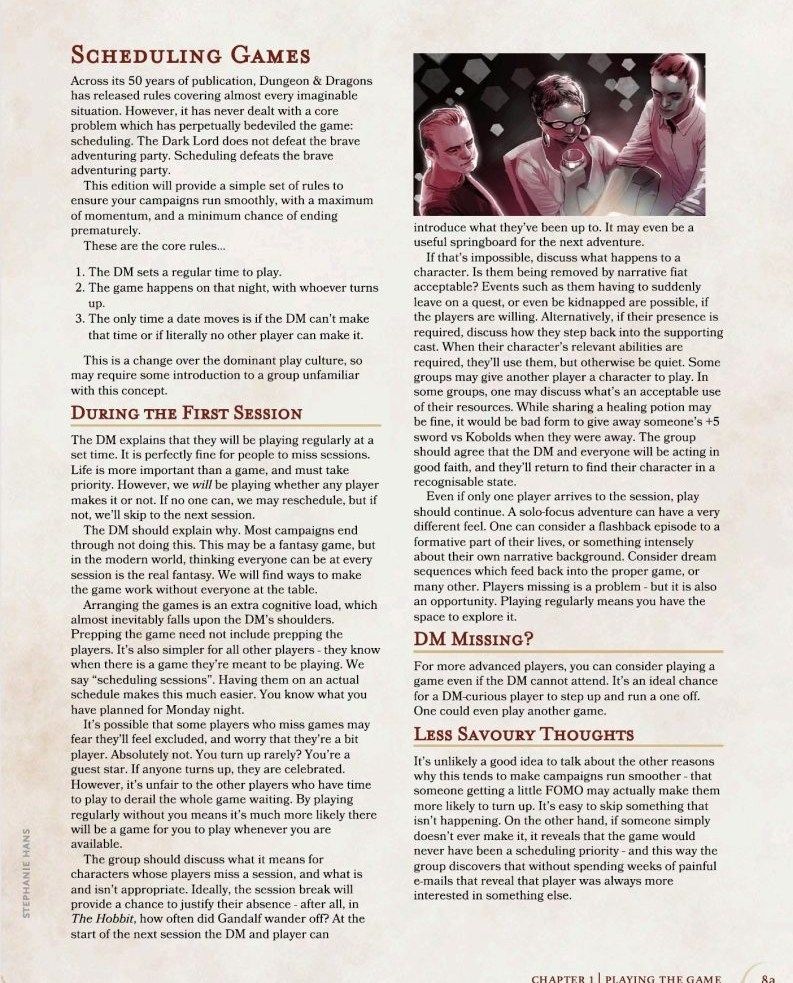
This week I saw a good take on scheduling for D&D.

https://www.polygon.com/tabletop-games/543536/dnd-dungeons-dragons-scheduling-handbook-patch

The Scheduling page the author suggests you print out

After I shared it, someone else sent me this Hank Green video about combinatorics, which explains the issue really well.

Ultimately, I think that people have trouble with D&D scheduling in part because of two of the Geek Social Fallacies: #5, “Friends Do Everything Together” and #1,  “Ostracizers Are Evil.”

But you don’t have to do everything together. Like I talk about in Nuclear Event Planning, it is okay to prioritize “I want to host this event” over “I want these specific people there.” (It’s also okay to do the reverse, but then you have to accept the high likelihood that “hosting the event” won’t happen.)

Nuclear event planning

One of the ways that I try to plan gatherings with my friends is a style I’ve taken to calling “nuclear” in my head: basically, you create a solid nucleus of reliable people who are able and willing to commit to attending the event, so you know it’s gonna happen regardless; and then, from there, you can slowly expand your guest list with people who might have more going on in their lives, or whatever, that makes them more of an Uncollapsed Social Waveform. (They’re your electrons.)

If the event involves accomodations, you can pick a specific date with your nucleus (perhaps via a Doodle poll or similar), and then pick a general geographic range before telling your electrons the plans. Have a firm RSVP deadline so you can book your lodging before the event itself! Alternatively, if you’re not wedded to the idea of renting one house together, you can just all get hotel rooms individually.