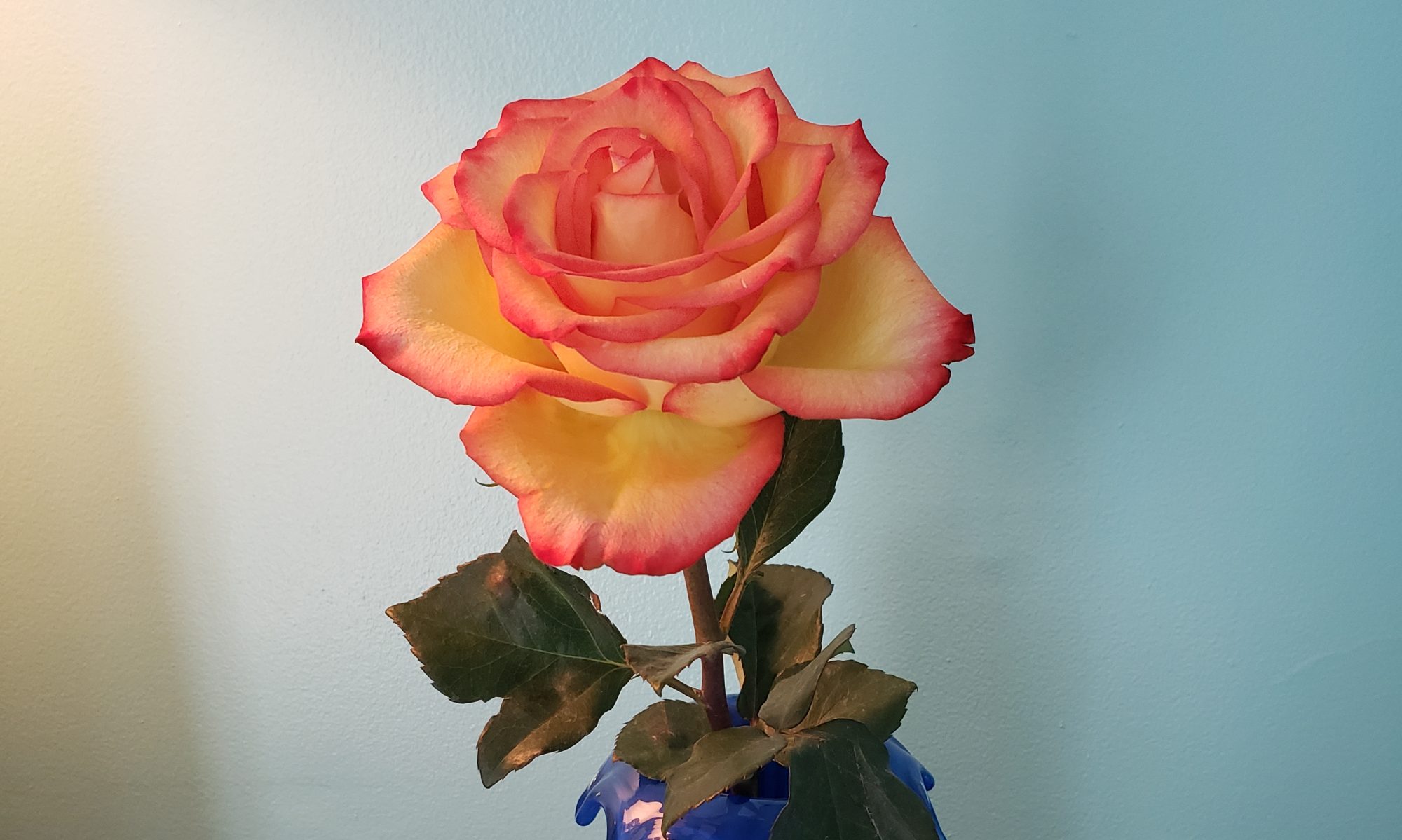
When you take precautions so that other people can’t hear you going at it, that’s called OPSEX.
Burned Haystack dating
Today I learned that this concept has a name – Burned Haystack. (I’ve heard of it before, but it didn’t have a name.)
Basically, the idea is to be as raw and honest and true as possible on your dating profile, so that you don’t waste time with incompatible people. It might take longer to find a person who meets your parameters, but they’ll be a better fit for your life and goals.
The metaphor is that if you’re looking for a needle in a haystack, it can be better to just set the hay on fire and then look for the needle in the ashes.
20+ years ago, advice columnist Carolyn Hax called hairy legs “a built-in doink filter.” I’ve always remembered that.
An orange rose
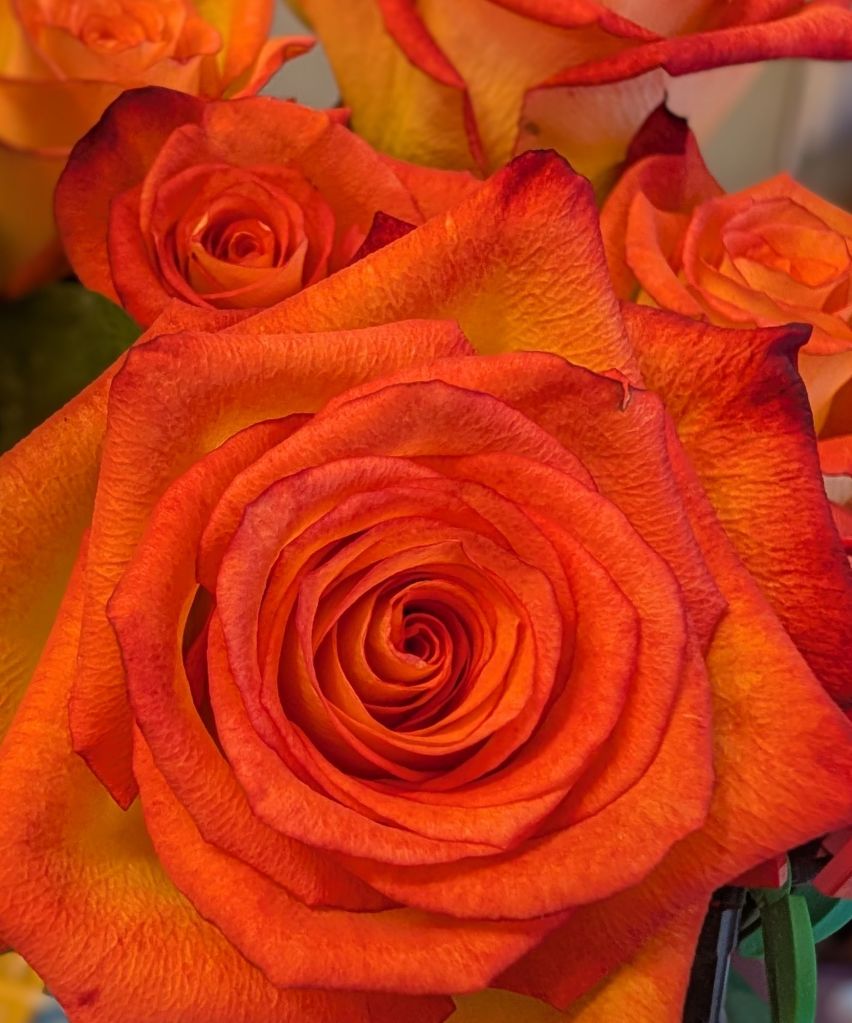
I remember, years ago, reading a poem about how red roses are for passion, and white roses are for committed love; so the ideal rose for a relationship is one that’s mostly white but with a blush of red on the tips of the petals.
That may be ideal for some people! But I would hesitate to claim it works best for everyone.
Today I was thinking about how my favorite roses are the ones that look like this. I have one as the background of this website, in fact.
Yellow, but with a goodly amount of red as well.
A yellow rose is for friendship.
This, to me, is the ideal relationship structure.
A close friend made this quiz for thinking about your relationship, as part of his work as a therapist. It can either be for analyzing an existing relationship, or for thinking about what your ideal relationship would look like. Anyway, I think it would work pretty well to visualize it with different rose colors, or with a full-om Tussie Mussie.
A comic about Boundaries
I need to save this for every time some person is like “waaah they crossed my boundaries” and then does nothing about it.
https://www.instagram.com/p/DL7TYCpsEDe/
Chivalry
Today I had a small epiphany: throughout the course of my life, I have had men and boys tell me that they wished chivalry was still around, so that they would know how to talk to women and girls/structure their interactions appropriately.
…Those guys were probably just on the autism spectrum.
Gonna chew on that for a little bit.
Anyway, a bonus How To People that I observed in a conversation today: if you are talking with someone (perhaps while walking towards the parking lot together) and the conversation dies down, it is okay to say “Well, good chatting with you, talk to you later!” and just wander off/speed up your pace/slow down. This is an accepted script for How To End A Conversation.
Dating and false negatives
The other day, a friend said something in a discussion group that really made me think about relationships and dating and how all of this even works.
I’m not an expert on dating. But I do have a lot of friends, and I read a lot of advice columns, and so I have started noticing a pattern.
Some people think that if they go on one date and it’s mediocre (not Bad, just Mediocre), if they’re not Feeling It ™️, then it’s not worth going on a second date with that person.
So.
While it’s fine for someone to adopt this strategy, it’s important to realize that it’s not going to give a high probability of getting together with someone for the long term. (Which is relevant if anything other than one-night stands is your goal! No shame at all to the ONS people, but you’re not my target audience here.)
Everyone has “off” days.
The dating profile is a paper-thin slice of who someone is. This is fairly well established, even though some people still insist on judging a book by its dating profile.
But even beyond that, the first date is a bologna-thin slice of who someone is. It’s still not very much data at all.
If you want to really see if someone is compatible with you, you will have to date them (not exclusively, you don’t need to be exclusive during this period, as long as you’re honest and clear) for a while. Otherwise you’re just gonna get a shit-ton of false negatives.
And sometimes, for some people, that’s what they want: some people are very risk averse, or have trauma, or similar things going on. It’s okay for them to say “I will take the false negatives in order to not put myself in danger.”
But it’s important to be aware that that is what you’re doing: piling up a bunch of false negatives in addition to the true negatives. This is an extreme strategy for extreme situations. It’s not a strategy with a good chance of success.
Internal vs External Processing
This Instagram reel highlighted a difference I haven’t been able to put into words before: Internal vs External Processing.
I know I process things by talking them out. I used to joke that I have an “external dialogue” rather than an internal monologue. But not everyone works that way.
Like the commenter said: this is one of those Differences that should be brought up in couples therapy and premarital counseling. Figuring this kind of thing out first can make solving the other problems exponentially easier.
Friendship means showing up
I have SO MANY FEELINGS about this.
https://rojospinks.substack.com/p/the-friendship-problem
Thought 1
You know, I have better luck with friendships where it’s maintained via a group chat. That way, even if I am busy, other people still answer each other, and I can jump in to the conversation when I have the spoons.
Thought 2
And so people have easily 1000 virtual friends, but no one they can ask to feed their cat.
I HAVE BOTH AND IT’S MAGICAL.
Thought 3
“place-based friendships” – this sounds like Third Places but also, yeah, friendship is what happens when you Show Up.
Thought 4
People outside the constraints of modern western capitalism
Call a spade a spade. This is the knowledge economy. This (moving away from your support system) is how the knowledge economy WORKS. It’s not capitalism that’s the problem; it’s a world where you move to where the jobs are, rather than working whatever job and staying in your home town forever.
But, with remote work…maybe it doesn’t need to? IDK.
But the alternative is we all work at the one textile mill in town. Either you move to where the opportunities are, or you stick to the opportunities available in the town where you were born.
Would I still be happy, if I were a schoolteacher and attended the local Methodist Church every Sunday? Quite possibly. Or I could be clawing down the yellow wallpaper.
Thought 5
The best thing you can do to prepare yourself for climate change is live in an area with a high degree of social trust.
YES THIS OMG.
This is what I tell people who are like “I need to move to get away from climate change” – babe, you already live in the Piedmont, and the best prep is knowing and trusting your neighbors.
Thought 6
And this comment on the original post is what I am talking about when I get tetchy about Stardew Valley working out in real life:
Living now in a small farming town in New England after being a global nomad all my life, I realize that lots of Americans have had that stable interconnectedness of community that I never experienced in cities and suburbs. Town government, church, volunteer Fire & Rescue, annual festivals etc all require hours of interaction with fellow townsfolk. A barn fire or loose animal rallies neighbors’ help and covered dishes are brought to the sick or grieving. Problem is, not many people under 70 are carrying on any of this. The younger generations have moved out or do not participate. It took a few years but now I know that behind the Norman Rockwell scenes, a lot of these folks despise each other. They smooth things over and show up to the raffle or the funeral anyway because of a sense of duty and fear of social censure, sentiments lost in more individualistic, anonymous cities and suburbs. I admit to plunging in as a newcomer only to find that the busybodies who run everything want my labor, but have their own friend and family circles and are not open to outsiders for close friendships. They bonded long ago over babies and can’t understand my life. Conformity seems to be the entry fee for most communities, always a challenge for free thinkers. No tidy lesson I’m afraid, just another perspective on the struggle for connection in our atomized times. Thanks for your thought provoking piece!
“Conformity seems to be the entry fee for most communities.” Yws. Consider the etymological roots of those words: both “conformity” and “community” carry an original meaning/connotation of “togetherness.”
It’s important to allow for non-conformity in general; being able to express yourself is an important part of self-actualization. But bear in mind that that’s just the tip of Maslow’s pyramid; if you don’t have the base layers, nothing else will matter because you’ll be dead. This isn’t intended to excuse communities that exile people over stupid stuff; but I think it does, at least, explain the emphasis on conformity for a lot of communities.
Anyway. Go read the other post. It’s good.
Disentanglement
A few years back, I read this essay about “The Most Skipped Step” (when opening up a monogamous relationship).
The post itself is specifically about the context of Non-Monogamy or Polyamory. However, I find it useful even for monogamous contexts, because it’s very important for the members of a couple to retain their autonomy and identity as individuals, even when they are exclusively having sex and romantic relationships with each other and no one else.
Our society prioritizes and elevates sexual and romantic relationships above all else; but our platonic connections with our friends are also important, and can be just as (or more) important than our romantic/sexual ones. If you fall ill, your spouse is likely to be your primary caretaker; but caregiving is hard work, and should never fall on just one person. This is where The Village comes in. And having strong loving friendships is so important for that kind of resilience and endurance.
So, without further ado: the essay!
https://medium.com/@PolyamorySchool/the-most-skipped-step-when-opening-a-relationship-f1f67abbbd49
I have been informed that the author of this essay is Problematic. I do not know the details; I’m just noting this as a reminder that we should read everything with a critical eye and really try to analyze it, not absorb it uncritically. (I expect you all to read my posts critically as well.)
On groups and dyads
A variety of painful circumstances in my life recently have crystallized out a thought, for me: as much as we want a Group to be a cohesive unit, the group is only as strong as the strength of its various dyadic friendships.
When a group that had been constructed around one central Hub Person implodes, the continuance of the group is dependent on whether any of the Spoke People had actually formed individual (“dyadic”) friendships with each other. Without those interconnected friendships, the group would wither away without its Hub. (And maybe that’s why some Hubs feel threatened when they’re no longer the gatekeepers of access to the other friends?)
And when a large enough group (40 or so people) forms, not everyone will be as close to everyone else in that group; so it’s up to the individuals to build (or not build) their friendships with one another. If one person is having a crisis and reaches out, I am finding that sometimes, a larger group is *less* likely to respond. It’s the small six person chats that get things done for each other; or it’s an existing dyadic friendship within the larger circle that recognizes the need and answers it.
Is this the Bystander Effect in action? Are the larger groups prone to feeling too helpless to help? Someone else will do it?
Is this an effect of geography? Some of my Discords are pretty geographically dispersed, and I think that makes it harder (though not impossible) to build those sturdier connections.
It can also be hard to know what/how someone needs help. With closer individual bonds, there’s more of a chance that the person helping will actually help, versus accidentally making things worse. (I know that’s a thing for me as well: I’ve made things worse so often.)
But I just had an absolutely terrible week, and all kinds of people came to my rescue; and I am so grateful. And I witnessed someone else leave a group because they weren’t getting the support they needed, and my heart aches for them; but we were never directly close with each other, either, so I felt too distant (geographically and emotionally) to help. So it goes.
But anyway, my point in all this rambling is: If you are in a large friend group, make sure you aren’t neglecting the individual connections with individual people. In the end, “The Group” is a legal fiction. The people that help you move are the real individual humans that you can bond with, or not, as life takes you.
But try to take care of each other. Yes, The Village is built on unpaid labor. It’s transactional even though it’s not tracked, or shouldn’t be tracked, because Village Support is about having help with specific concrete actions that need doing.
I don’t know. I’m rambling and tired. But just. Look for the helpers; and be the helpers, when you can.
 Emilybook