“I like this one. It matches the esque of your glasses.”
I’ve never heard “esque” (like the productive suffix used to make an adjective) used in this manner before, but I love it!
Ten pounds of personality in a five-pound bag
“I like this one. It matches the esque of your glasses.”
I’ve never heard “esque” (like the productive suffix used to make an adjective) used in this manner before, but I love it!
I’ve had a couple young people side-eye my use of “skeet” for micro blogs posted on BlueSky.
To them I say: this feeling you have right now? I spent decades feeling that about the word “cyber.”
And now I wonder what the next unintentionally horrible word will be?
Years ago, I learned this phrase from… Captain Awkward, I believe?
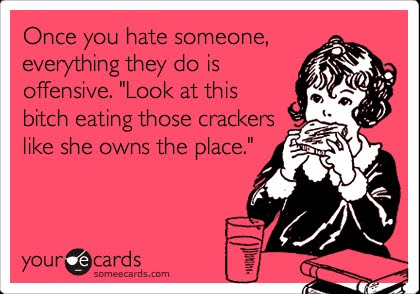
I use this phrase pretty frequently, mostly to acknowledge my own irrational reactions to people I don’t particularly enjoy.
A little while ago, I heard about a useful term for discussing the issue of cultural appropriation versus appreciation: closed practice.
In brief (others can link to longer explanations if they wish), the idea is that some things are a Closed Practice (that only people in that culture can really appreciate and participate in), and other things are an Open Practice (anyone is free to do the thing, without censure from anyone except overly enthusiastic 14yos on Tumblr).
As an example: tattooing is not a Closed Practice. Many, many cultures have tattooing as a tradition, and it’s not appropriation to get a tattoo. However, there may be specific tattoos that would be considered closed practices. Like something related to a coming of age ritual, or similar.
I’m not using specific real examples in this post, because I don’t want to get bogged down about one culture or another. But in general, if you’re trying to have a good faith discussion with someone about whether a given thing is appreciation or appropriation, ask: Is this a closed practice or an open practice?
Recently, via this Ask Historians reddit thread, I discovered the term Hallucination in the context of Artificial Intelligence.
I’ve known about this concept for a while; neural-net machine translation will often produce “better English,” at the cost of…yanno….accuracy. But all anyone ever sees is how clear and not-clunky the English sentence is! They ooh and aah over how magical the new tech is; but the problem of “did this actually translate CORRECTLY” has not gone away with the new technology. It’s still as present as it ever was. And the pretty English outputs make us more likely to trust the imperfect tech; the old “your purple cabbage grandmother” outputs gave us an appropriate amount of distrust for the machine.
That’s a suitable analogy for the rest of AI. It can be pretty. It’s not bad. But don’t think of it as the same kind of reliable as human-produced content; it’s not even the same kind of unreliable as human-produced content. That’s the part that worries me most.
April 2023: Found this TikTok about spaghetti photos and how they’re likely shaped by the biased data (the only photos going into the engine are likely of toddlers making a cute mess). As she says, “AI is an Ask The Audience robot, and the Audience is the general Internet-using public.”
 Emilybook