I just wanted to make a post to save this article from Cornell about pawpaws.
Everything doesn’t happen for a reason
Years ago, I read this essay by Tim J. Lawrence, “Everything doesn’t happen for a reason.”
One of my extended family members goes into hospice this week, so it’s been on my mind.
Some things in life cannot be fixed. They can only be carried.
He is one of the kindest people I have ever known. So was the first uncle I lost that I really knew well. (The first member of that generation to pass away in my family was an uncle who sustained brain damage at age 2, and as such I never really got to know him.)
I have already lost people my own age (though not in my family). I have already lost members of older generations. But the creeping onset of mortality is just getting more real, year after year.
But the goal, here, remains the same: Make your own purpose in life. And be kind to one another.
Your kids aren’t feral. They’re TODA.
A few years ago, my mom group started looking for a term for those little moments where your kid is being, by any objective measure, a complete asshole to you and everyone else around you, but you don’t feel right being mad at them because it’s developmentally normal for them at that age.
Eventually, one woman came up with “Totally Obnoxious, Developmentally Appropriate,” or TODA, and it stuck. I’ve started using it in other groups, and I hope the concept spreads, because it’s just so important to be able to hold both things in your head simultaneously: that yes, it’s normal for your kid to behave this way; and yes, it’s normal for you to be upset with that. Both of these things are true.
Since I’m now seeing a big age gap between my child and my peers’ younger children, it’s been helpful to have the reminder that “this child has no control over their limbs, hates clothing, and wants to touch anything and anyone without a single care for that person’s consent” is not/NOT that child being feral! It’s that child being Totally Obnoxious, Developmentally Appropriate. And soon, they will grow into wonderful little humans who respect other people, because their brain will get there. Just as my child’s brain got there.
And boy howdy, am I not looking forward to adolescence. 😂 I think that’s when my friends with their sweet little upper elementary schoolers will wonder if my teen is feral. But she won’t be feral. She’ll just be TODA.
Saving for your children
Today I saw this Tweet, and wanted to highlight it here:
There are a lot of responses to her (some in good faith, some not). I’m glad that she is also prioritizing her own retirement accounts! I’m guessing the account she mentions is a custodial (UTMA/UGMA) account; that’s a good way to save a relatively small (couple thousands?) amount of money for a child, but if you have Lots Of Money ™, you should really consider other vehicles, such as a trust. I suspect that as this woman’s nest egg for her daughter grows, she will take stock of the situation and adjust her investments accordingly.
Most 18-year-olds would not be able to handle a sudden influx of cash like that. However, if you do a good job of explaining money and savings and delayed gratification to your child, then this sort of savings can be a gift, rather than a burden or a source of regret and pain. While I’m hesitant about the idea of “here, have money!” upon turning 18, my guess is that someone like this Internet person would have done all the legwork to make sure that her kid would have the skills to handle that money, not just have the money itself.
Children are an {individual|collective} responsibility
A few years back, someone linked me to this essay by Barbara Kingsolver, from 1992: “Everybody’s Somebody’s Baby.” It’s a beautiful reflection on the nature of children in society, and what it means when we treat them the way we do.
My second afternoon in Spain, standing on a crowded bus, as we ricocheted around a corner and my daughter reached starfish-like for stability, a man in a black beret stood up and gently helped her into his seat. In his weightless bearing I caught sight of the decades-old child, treasured by the manifold mothers of his neighborhood, growing up the way leavened dough rises surely to the kindness of bread.
Kingsolver
My working theory, here, is that in America, we see children as Not Belonging in public life paradoxically because so many of us have been pressured into having them. I know that I am lucky: I wanted children, and I have an amazing child. But other people are childfree by choice, and while some are benevolent towards the mere existence of children, others cannot stand to have them around.
I think the optimal solution, like most optimal solutions, lies somewhere in the middle: We stop pressuring people to have kids when they don’t want them; and we stop acting like kids are this horrible Other Species, barely even human (see the man who called a child “it” in the essay).
It’s absolutely appropriate to say that children should not be in some places; not every location, every entertainment, is intended to be enjoyed by every human. But bans like that need to be considered thoughtfully and reasonably. Take weddings, for example, the source of so much internecine drama. It’s absolutely fine for the people getting married to say “We would like to have a party that is just adults” – it sets a certain tone, it allows for fragile objects to be placed on tables, etc etc etc. But the spirit of that request does not mean banning the 17yo twin when her 18yo twin had the good fortune to be born at 11:47 pm, rather than 12:01 AM. It does not mean banning a nursing infant who is not even ambulatory yet (a ban which functionally also bans the other half of the Nursing Dyad). Acknowledging that children are part of our world means making places for children – not just banning them from things. Allowing the 17yo twin or the nursing infant does not require you to also allow the shrieking, running 5yo. (Though if you want the 5yo’s parents to attend, the best chance of that happening is to provide on-site childcare, since the logistics of babysitting in a strange city are dicey at best, and all the normal family caregivers are likely at the wedding already.)
And all this comes back to the question raised in the subject line here: are children an Individual responsibility, or a Collective one? My feeling is Collective.
(And I will ask another friend if I can get a copy of her essay “Parenthood, and the Irrational Concept of ‘Choice’,” to also post up here, because it handles the question of Individual vs. Collective so well.)
https://www.tiktok.com/t/ZTRfKUh7L/https://www.tiktok.com/t/ZTRfKUh7L/
This TikTok expresses a similar idea through an explicitly leftist lens: that if you build a community that is inhospitable to children, you functionally make it inhospitable to women, and all you will do is reconstruct the existing patriarchy.
Insulin should be free
Today I saw this tweet, and I agree.
Impossibly nerdy finding
Today I found this scribbled on a piece of steno paper:
im elenloth. man lasto beth i caran-ner. i nen-ner. i perihoth. i narlothcham.
“Caran-ner” is not defined, but that means Redman.
Nen-ner seems to mean water-man, but I’m not sure what that is supposed to indicate.
There are also definitions listed; “perihoth” means Minibosses and “narlothcham” means Armcannon.
I was probably listing out some DJ set from Magfest.
I initially thought this paper would have been from around 07 or 08, but next to “narlothcham” i also have the Pashto letter ښ written as a pronunciation guide for the ch, so this is probably more like 2010 or 2011.
This is a hell of a look inside my brain.
Budgeting isn’t dieting
Mandatory disclaimer: I am writing this post from the perspective of a middle-class person addressing other middle-class people. I do not wish to imply that Anyone Can Do These Things; only people with a certain ration of Income to Needs can solve problems like this by budgeting. If your reaction to this post is “but I can’t budget my way out of poverty,” then do not fret: this post is not at or about you. If your reaction to this post is “but not EVERYONE can budget their way out of poverty,” then I will reiterate the intended audience for this post: Middle-class people. Not Everyone. Thank you for understanding!
A few weeks ago, I read a secondary source (Reddit post about an article, haha!) that discussed the question of “Is budget culture as harmful as diet culture?”
Seeing this concerned me, because I’m well aware of (and pretty vocal about!) how damaging diet culture is, and how the whole weight loss scheme system is destroying generations of people’s bodies and minds. And at the same time, I’m a huge proponent of being conscious of your budget, making sure you’re spending carefully, and things of that nature. So my immediate concern was: am I perpetuating a harmful shame culture by being so enthusiastic about budgeting?
But today, I had a small analogy-epiphany about it. In my view, budgeting isn’t the idea of dieting that says consuming is sinful, taking up space is sinful, your natural inclinations are evil and must be punished, good things must be “earned” and aren’t there to simply be enjoyed.
Rather, I think that budgeting is much closer to the idea that I subscribe to re: bodies and food and exercise. Namely: you exist and you do things. Eating food lets you do things, food is fuel, you need food in order to let your body do all this amazing stuff. It’s not a perfect philosophy; for example, it doesn’t address the frequent moralizing about disability or the ableism that can permeate even fat-positive spaces. But in general, I’ve found it the best way for me to conceptualize food and exercise and weight. Having A Body is the thing that lets me Do Stuff. That’s awesome.
In a similar fashion, having a budget (knowing what you are spending money on, and making sure that you are spending money on what you want to spend money on) is Having A Finance that lets you Do Stuff.
In your life, you undoubtedly have goals. Are you hoping to purchase a house? Send your children to college without the crippling burden of student debt? Pay off your own debts? Save for your retirement? Having a budget lets you actively choose those long-term goals in addition to living your day-to-day life now. (And unlike calories, dollars really are a zero sum game: dollars in, dollars out. Finance is binary like that in a way that Bodies are not.)
My personal view is that the best first step is to look at your Descriptive Budget: what am I currently spending money on? How do those expenses stack up against my total household income? How many of those expenses are recurring (mortgage) or periodic (car insurance)? And is my income biweekly, monthly, quarterly, or irregular (e.g. book advance)? Taking all of those things into account for the Descriptive Budget will help you formulate a Prescriptive Budget if you find you are over-spending on some things (like travel, or cute enamel pins on Etsy, or whatever).
To bring the analogy back around full circle: The actual, harmful, diet-culture-equivalent thing for Finance would be something akin to the Prosperity Gospel: the idea that you are only worthy if your income, or net worth, or whatever is above a certain level. That is the unhealthy thinking, in the world of personal finance.
But the healthy thing – the thing I’m advocating for, in all of my “being the finance nerd” in my social circles, is this: We should focus on the Stuff We Want To Do (save for future? go on trips to broaden our horizons?), and then take actions so that we can accomplish that Stuff.
Don’t look at the number on the scale. Don’t look at the total net worth in your spreadsheet. Look at what you’re able to do, look at what you want to do, and remember those long-term goals when you are making short-term spending decisions!
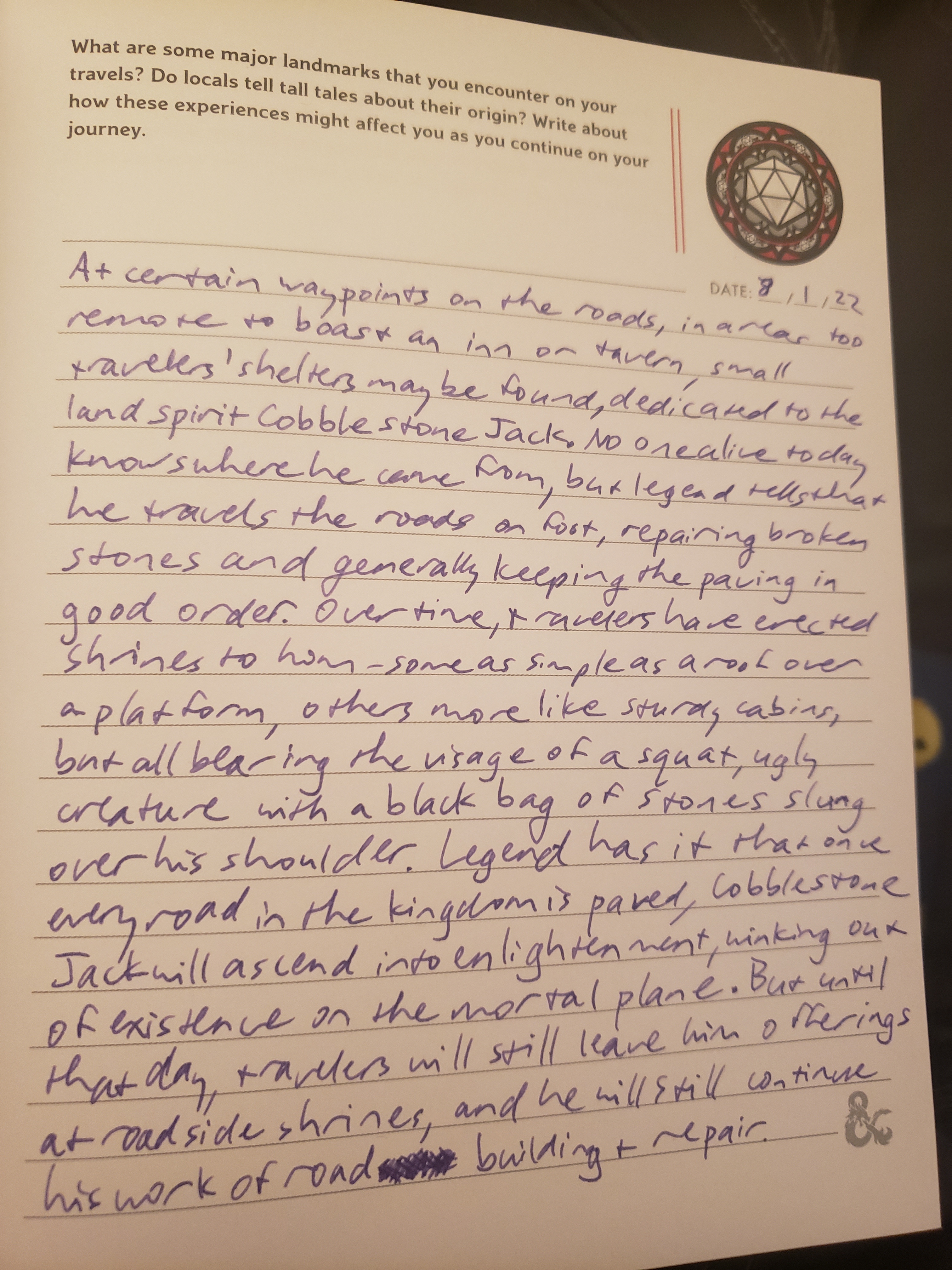
Cobblestone Jack
“hey remember that time you summoned a dretch to interrogate him about his demon lord’s plans and he begged you not to send him back to the Abyss so you gave him a task that was non infinite but might as well be?”
A short D&D concept: Kord’s Arena
Imagine a world in which the church of Kord runs sanctioned fight clubs, where people can do various types of combat sports (such as boxing, wrestling, feats of strength, etc) to the greater glory of the god.
Doping/non-doping (magic/non-magic) options are available: the national or international level Non-Magical championships would take place in a large arena with an Antimagic Field cast over the fighting area. For the Magical championships, a facilitator with Detect Magic or a similar spell on would identify and announce each spell present on the competitors immediately before the match.
Each arena, even the smallest, would be staffed by a low-level cleric or paladin of Kord who tends wounds after the match.
This concept can easily be expanded to other deities in other pantheons, e.g. Tulkas.

