I learned about this today and I love it.


Ten pounds of personality in a five-pound bag
A few years ago, I remember the Romney family getting in hot water rhetorically speaking because one of them (I think it was Ann?) said something very tone-deaf about financial difficulties. It was along the lines of “Yes, we too have known poverty. Why, one time during graduate school, we had to sell some stock to make ends meet!”
I think about this a lot, when I see finance getting talked about on the Internet. If you are well off, there’s a certain level of desperation that you will simply never know, because you have enough cushion/backup (whether that’s from your own savings, family support, or savings you have BECAUSE of earlier family support).
One of my friends and I have a running gag about the very un-self-aware articles that are sometimes published in places like Business Insider. You probably know the drill: “This plucky young lad paid off $120,000 of student loans before age 30! What an inspiration!” Then you read the article and (a) there is no budget presented, and (b) the most mathematically significant “tip” offered is something like “He chose to live with his parents to save money on rent” (good! If you can swing it!) “and also rented out the Harlem condominium his grandmother gifted him upon graduation for $4000 a month of extra income! What a hustle grindset, am I right?” (Laughably out of reach for almost everyone in the country).
The thing that makes these puff pieces laughable is the lack of a written budget and the lack of comparability to even the median American, let alone the lower quartiles.
Someone recently shared this article in a space I’m in, and people immediately started talking shit about the interviewee. At first glance, I agreed – if he’s got very wealthy parents, that’s why, right?
But then I actually clicked on it, and there were a couple features that made this different from the normal puff pieces.
I would have preferred slightly more acknowledgement that not everyone can join the military (due to medical restrictions and so forth) but overall? It’s actually a pretty good article.
Anyway. I was just having some feelings about that, and it made me think of the “Romney poor” concept at the same time.
It’s important to keep things in perspective, no matter what stage of the journey you’re on.
My friend B Brookshire wrote this essay recently, and I wanted to share it here.
https://brookshire-team-trash.beehiiv.com/p/the-neverending-stress-cycle
The news is the lion and I am a hapless zebra.
Our bodies and minds aren’t built to deal with this much stress all the time. We have to adapt our behavior to cope healthily.
I think this is a really good explanation of why it’s important to not assume what other people are thinking.
https://www.instagram.com/reel/DL9yBL_NJzc/
I used to have a friend who would get SO CONVINCED that other people hated her, based on various indicators. As an outsider to her interactions, my perspective would generally range from “hmm, I don’t think they actually thought anything about you at all” to “I think they were actually sympathetic” to “they’re just in a bad mood, but that doesn’t mean they hate you.”
It’s much better and less exhausting to not assume everyone hates you.
I need to save this for every time some person is like “waaah they crossed my boundaries” and then does nothing about it.
https://www.instagram.com/p/DL7TYCpsEDe/
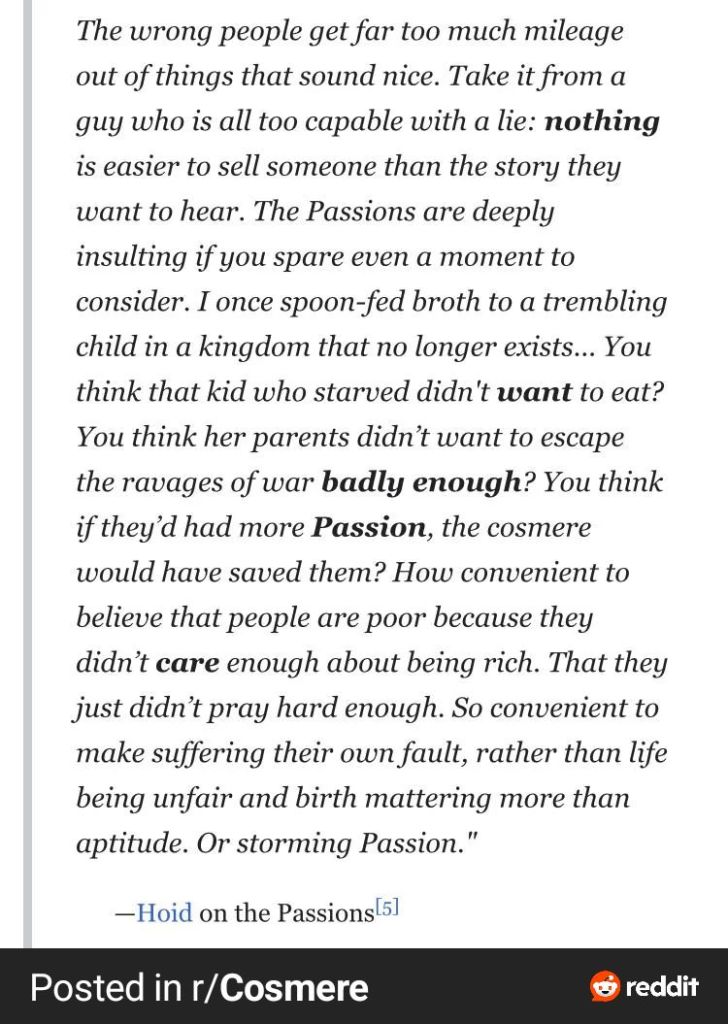
I recently saw this image shared around (I’ll try to grab alt text for it), and it’s a great example of the Just World Fallacy.

I found this article on the Guardian to be a helpful framing of the current, well, Everything.
The other day, a friend said something in a discussion group that really made me think about relationships and dating and how all of this even works.
I’m not an expert on dating. But I do have a lot of friends, and I read a lot of advice columns, and so I have started noticing a pattern.
Some people think that if they go on one date and it’s mediocre (not Bad, just Mediocre), if they’re not Feeling It โข๏ธ, then it’s not worth going on a second date with that person.
So.
While it’s fine for someone to adopt this strategy, it’s important to realize that it’s not going to give a high probability of getting together with someone for the long term. (Which is relevant if anything other than one-night stands is your goal! No shame at all to the ONS people, but you’re not my target audience here.)
Everyone has “off” days.
The dating profile is a paper-thin slice of who someone is. This is fairly well established, even though some people still insist on judging a book by its dating profile.
But even beyond that, the first date is a bologna-thin slice of who someone is. It’s still not very much data at all.
If you want to really see if someone is compatible with you, you will have to date them (not exclusively, you don’t need to be exclusive during this period, as long as you’re honest and clear) for a while. Otherwise you’re just gonna get a shit-ton of false negatives.
And sometimes, for some people, that’s what they want: some people are very risk averse, or have trauma, or similar things going on. It’s okay for them to say “I will take the false negatives in order to not put myself in danger.”
But it’s important to be aware that that is what you’re doing: piling up a bunch of false negatives in addition to the true negatives. This is an extreme strategy for extreme situations. It’s not a strategy with a good chance of success.
Many years ago, my uncle gave me a book called “How to Lie With Statistics.” It outlined a number of different ways that statistical data, while Technically Correct, can be used to misrepresent reality.
Explaining why “The numbers don’t lie” is an overly simplistic way to look at the world is even more important today, I think.
This morning, I saw this Instagram post about the red wine study, and how it missed (or deliberately ignored) the fact that many “non-drinkers” choose abstinence because of their health conditions, so they’re going to be a slightly unhealthier population to begin with. I’m sharing it here.
https://yourlocalepidemiologist.substack.com/p/vitamin-a-and-measles-what-the-data
This post, by Your Local Epidemiologist, makes a good point about people gravitating to nutrition and other solutions to infectious disease, rather than vaccination, because they want to feel a sense of control over their environment. It’s very difficult and scary for humans to accept the randomness inherent in the natural world; we’d rather have a way to say “I am controlling what happens to me,” and controlling what food goes into your body is a natural extension of that.
Vaccines are abstract (and still a numbers game; even 99% efficacy is still not 100% efficacy), and they don’t provide the soothing effect that “actively choosing your food every day” would provide.
https://en.wikipedia.org/wiki/Just-world_fallacy
The Just World Hypothesis is comforting for that same reason of control. We want to feel like good things happen to us because we made good decisions; bad things happen to others because they made bad decisions; and bad things happen to us for reasons we could not control. Nobody wants to confront the harsh reality that sometimes, bad things can happen even to people who made all the right decisions.
Anyway, go read the YLE essay. It’s very good.