Word of the day: closed practice

A little while ago, I heard about a useful term for discussing the issue of cultural appropriation versus appreciation: closed practice.

In brief (others can link to longer explanations if they wish), the idea is that some things are a Closed Practice (that only people in that culture can really appreciate and participate in), and other things are an Open Practice (anyone is free to do the thing, without censure from anyone except overly enthusiastic 14yos on Tumblr).

As an example: tattooing is not a Closed Practice. Many, many cultures have tattooing as a tradition, and it’s not appropriation to get a tattoo. However, there may be specific tattoos that would be considered closed practices. Like something related to a coming of age ritual, or similar.

I’m not using specific real examples in this post, because I don’t want to get bogged down about one culture or another. But in general, if you’re trying to have a good faith discussion with someone about whether a given thing is appreciation or appropriation, ask: Is this a closed practice or an open practice?

Best friends

I’ve had best friends before.

One, or six, or fourteen at a time?

At this stage in my life, I think the whole concept of a best friend is children play-acting at monogamous marriage before they’re ready or interested in a romantic relationship with anyone.

I still remember the agonizing feelings I had when someone else got to be The Best Friend when I wanted to be.

And I remember the guilt I felt when I drifted apart from my closest friend of childhood. Was I, somehow, divorcing her?

I’ve had “friend breakup” talks, as an adult. They were painful, but a necessary part of being compassionate to someone you once (and still) care(d) about.

One of my friends in college told me, “Best Friends isn’t a single job; it’s a tier.” I didn’t believe her then. I do now. (And her husband is the person I’d pick if I was forced to pick a single best friend, which is an amusing bonus anecdote.) For the most part, I don’t have a single best friend; I have a rotating cast of friends who are all close to me in different ways. One friend is my local emergency contact for everything. The other (aforementioned) is my advance directive POA. Yet another pair are the designated guardians for my child in case both my ex husband and I pass away.

A friend today shared a post about how “best friend” is a term that imitates monogamy, and it made me think about all this. (I don’t have the link handy, but I’ll add it when I do.) It’s been percolating in my mind for a while, but I haven’t really put it into words.

It’s not realistic to expect one person to be all those friends for you; different people are different, and every dyadic friendship has its own shape. They don’t take away from each other, except inasmuch as time and energy are limited things.

I am grateful, though, for all the friends that I do have, and for all the friends I used to have. You have all touched, shaped, my life in one way or another.

I’m glad that I don’t have to pick one friend to be a Best Friend.

On parenting adult children, and estrangement

Recently, my browser decided to give me this article from Psychology Today.

Why your adult child treats you like dirt

It gives some really thoughtful suggestions for the parents who actually do want to reconnect with their children, and who are willing to be introspective and to think about what their behavior may have contributed to the current situation.

Continue reading “On parenting adult children, and estrangement”

Rules and Boundaries, cat edition

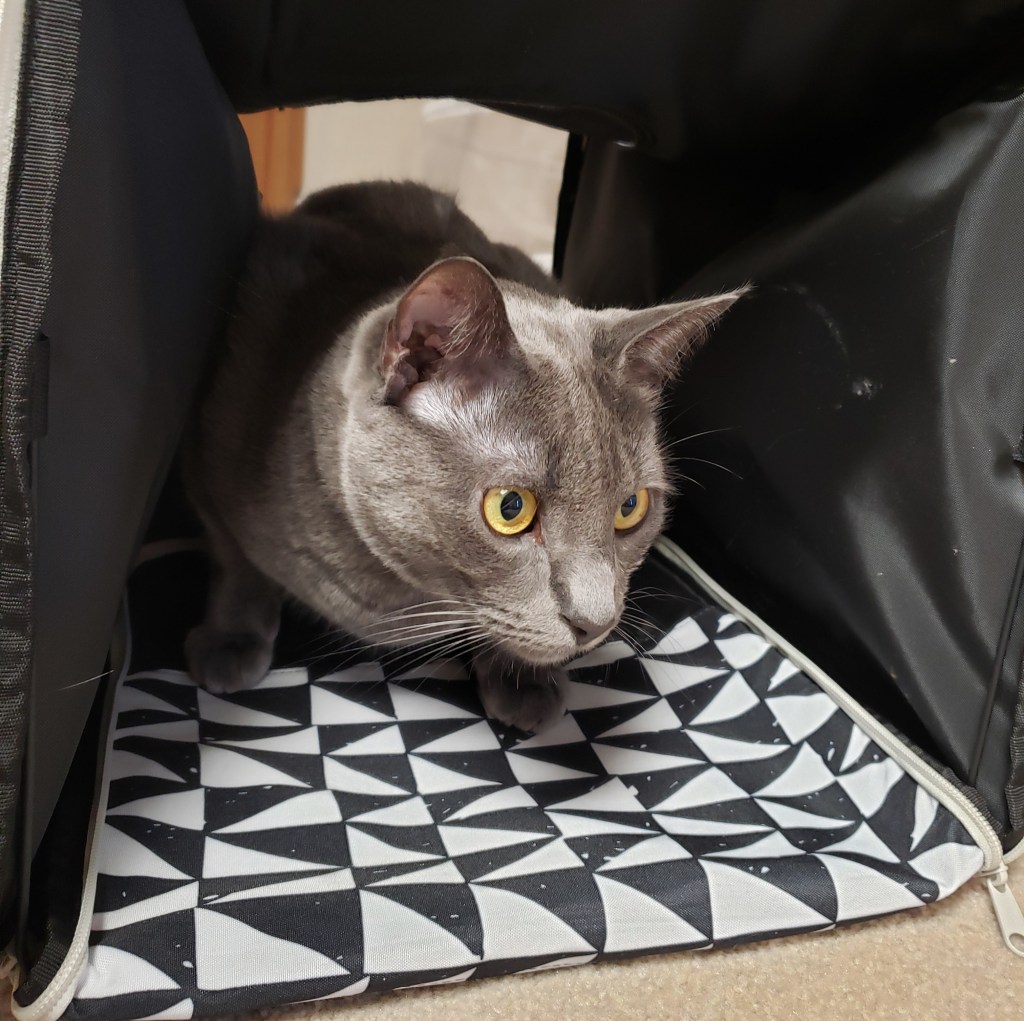
Last night, I accidentally taught my kid about the difference between Rules and Boundaries by using my cat as an example. See, my cat (Cloud, 2M) is a bit of an asshole sometimes. He likes to jump up on my dresser while I’m sleeping and bat things around and make noise. As a result, I’ve started locking him out of my bedroom at night, so that I can have good sleep hygiene (a serious issue for me right now in my life).

So last night, my daughter was like “Why are you punishing him? He’s just being a cat!” And, you know, she’s right! But also, I have the right to sleep without disturbance. So I launched into the explanation that I cannot control Cloud, but I can control what doors are open or closed in my house.

Then, I realized that this was a perfect way to segue into the difference between making rules for someone else versus setting a boundary for your own self!

I emphasized that I cannot control Cloud or his actions myself. I can say โ€stay off the dresser” until I’m blue in the face, but ultimately I’m not the one that controls his actions. What I can control is my actions. I can lock him out of my room in order to be healthy and get enough sleep. That’s within my locus of control.

Then I drew a parallel to a real life conundrum she might face someday: say, dating a person who is a smoker. She can say “You can’t smoke in my house.” She can say “If you smoke, I will break up with you.” But she can’t say “You are not allowed to smoke.” That’s not within her locus of control.

Anyway. I hope this lesson sticks with her as she grows up and makes her own way in the world.


Cloud, in carrier

I also found this video on Instagram, which explains boundaries from the cat’s perspective.

Nuclear event planning

One of the ways that I try to plan gatherings with my friends is a style I’ve taken to calling “nuclear” in my head: basically, you create a solid nucleus of reliable people who are able and willing to commit to attending the event, so you know it’s gonna happen regardless; and then, from there, you can slowly expand your guest list with people who might have more going on in their lives, or whatever, that makes them more of an Uncollapsed Social Waveform. (They’re your electrons.)

If the event involves accomodations, you can pick a specific date with your nucleus (perhaps via a Doodle poll or similar), and then pick a general geographic range before telling your electrons the plans. Have a firm RSVP deadline so you can book your lodging before the event itself! Alternatively, if you’re not wedded to the idea of renting one house together, you can just all get hotel rooms individually.

The Relationship Escalator

In the reading I’ve done on non-monogamy, there’s a concept that I really like called the Relationship Escalator. I don’t have the link with me right at this moment (will add later – here is the original essay!), but the general gist is that in our society, we have this concept of RELATIONSHIP that goes from DATING to COHABITATION to ENGAGEMENT to MARRIAGE to BUY HOUSE to HAVE BABY, with only minor deviations or reordering permitted.

The idea of “stepping off the relationship escalator” means that you are allowed to opt out of any or all of these steps, without guilt or feeling like you are Doing The Relationship Incorrectly. For monogamous people, this can mean accepting that it’s fine to never get married, if that’s what you want! Or even never cohabitating – some people are just happier living alone. It can also even help with framing around asexual relationships: not every relationship needs to involve sex in order to be considered just as important and valid!

For non-monogamous people, more specifically polyamorous people (who are concerned with the construction of multiple loving relationships), stepping off the Relationship Escalator can mean establishing a different kind of relationship with different partners, according to the varied needs and desires of the people involved. Having the explicitly-outlined option of “we don’t HAVE to do all of those things in order to be in a loving relationship together” allows for a lot more flexibility in creating long term relationships.

I have a set of polyamorous friends where one married couple has been together for fewer years than the wife has been with her non-marital partner. Number of years together is not assumed to be an indication of the relationship’s Seriousness, or of any Expected Next Action To Be Taken. She has dated one person for longer, but she has married and had children with the other one, because those are the choices all of them made.

Carolyn Hax (one of my favorite advice columnists) calls it the Conveyor Belt: https://www.washingtonpost.com/lifestyle/advice/carolyn-hax-they-are-ready-on-paper-for-a-baby-but-what-about-the-real-thing/2021/03/23/a0e198b4-836a-11eb-9ca6-54e187ee4939_story.html – different word, but same concept.

I think this is a good framework for anyone who’s in (or wants to be in) a relationship to reflect on: what do you want, out of your relationship(s)? How much do you want one thing versus other things? What are you willing to compromise on?

Other people have called this concept the Relationship Smorgasbord (to avoid defining various choices as Above other choices). I’ll find that link, too, and add it here. It’s a good thing to talk about with potential partners, to think about what you want with someone else in general or in specific.


Bonus links:

https://solopoly.net/2012/11/29/riding-the-relationship-escalator-or-not/

https://www.washingtonpost.com/wellness/2024/09/27/relationship-escalator-marriage-polyamory/

Your kids aren’t feral. They’re TODA.

A few years ago, my mom group started looking for a term for those little moments where your kid is being, by any objective measure, a complete asshole to you and everyone else around you, but you don’t feel right being mad at them because it’s developmentally normal for them at that age.

Eventually, one woman came up with “Totally Obnoxious, Developmentally Appropriate,” or TODA, and it stuck. I’ve started using it in other groups, and I hope the concept spreads, because it’s just so important to be able to hold both things in your head simultaneously: that yes, it’s normal for your kid to behave this way; and yes, it’s normal for you to be upset with that. Both of these things are true.

Since I’m now seeing a big age gap between my child and my peers’ younger children, it’s been helpful to have the reminder that “this child has no control over their limbs, hates clothing, and wants to touch anything and anyone without a single care for that person’s consent” is not/NOT that child being feral! It’s that child being Totally Obnoxious, Developmentally Appropriate. And soon, they will grow into wonderful little humans who respect other people, because their brain will get there. Just as my child’s brain got there.

And boy howdy, am I not looking forward to adolescence. ๐Ÿ˜‚ I think that’s when my friends with their sweet little upper elementary schoolers will wonder if my teen is feral. But she won’t be feral. She’ll just be TODA.

The Advice Column Paradox

I didn’t invent this term, but I think it’s a really excellent one, so I’m going to share it here. If you have an earlier citation for the use of this phrase, please leave it in the comments!

The Advice Column Paradox: nobody writes into an advice column when things are going well.

The Advice Column Paradox: nobody writes into an advice column when things are going well. When we vent to our friends about our marriages, but don’t share the positive things, they may think things are worse than they are; but sometimes, there just aren’t positive things. (It’s why I always took pains to say “There’s good stuff too, I just don’t need help processing THAT” whenever we had these discussions. I try to be self-aware at least a little bit.)

It is very common to see, on Internet advice boards like r/relationships or r/AmITheAsshole, people complaining in the commenters always jump straight to “omg, divorce!” But what those people miss, I think, is the core of this paradox. If you are writing in to an Internet advice column, it is because something has gone wrong. Something may have gone so very wrong that they are writing in to an anonymous forum to ask for help. There is a strong possibility that they feel ashamed or afraid to ask the other people in their lives for help. The people who say “Modern couples are too quick to divorce” are either not saying that in good faith, or are ignorant of the fact of the Paradox. I don’t have a snappy name for this one; maybe we can call it the “Why So Much Divorce Corollary” or something.

Ultimately, this paradox and the corollary of people being confused by it is an example of selection bias. “You Should Break Up” being given as relationship advice is not overly common, percentage-wise; if half the advice column responses are “Break up!” and 1 in 100 people are writing into an advice column in the first place, then only half a percent of relationships are getting the “you should break up” advice. If you scale that out into the real numbers, it’s even smaller.

So, no: Advice column readers are not “too hasty” to tell people to divorce. And our culture is not somehow “devaluing” marriage by telling someone who is locked out of a bathroom while pregnant, or worse, that they need to leave to protect themself.

Analogies of Privilege

This post is a set of essays that I have read that explain privilege, and specifically poverty/class privilege, in ways that really make sense to me. I’ve tried to put them in approximately chronological order, but WordPress doesn’t seem to appreciate that.

Sam Vimes “Boots” Theory of Economic Unfairness (1993)

The theory can be found on the L-Space Wiki. It’s a great illustration of how starting off a little bit ahead can have a compounding effect into the future: buying quality things that last means you don’t have to spend more money on lower-quality things that need frequent replacement.

โ€œThe reason that the rich were so rich, Vimes reasoned, was because they managed to spend less money.

Take boots, for example. He earned thirty-eight dollars a month plus allowances. A really good pair of leather boots cost fifty dollars. But an affordable pair of boots, which were sort of OK for a season or two and then leaked like hell when the cardboard gave out, cost about ten dollars. Those were the kind of boots Vimes always bought, and wore until the soles were so thin that he could tell where he was in Ankh-Morpork on a foggy night by the feel of the cobbles.

But the thing was that good boots lasted for years and years. A man who could afford fifty dollars had a pair of boots that’d still be keeping his feet dry in ten years’ time, while the poor man who could only afford cheap boots would have spent a hundred dollars on boots in the same time and would still have wet feet.

This was the Captain Samuel Vimes ‘Boots’ theory of socioeconomic unfairness.โ€

Terry Pratchett, Men At Arms – Goodreads link

Being Poor (2005)

I read Scalzi’s “Being Poor” in 2005, after Katrina. It affected me a great deal, and – in a lot of ways – really put me on the road to being the person I am today, with regards to how I look at The Meritocracy and so forth.

Being poor is people who have never been poor wondering why you choose to be so.

The high cost of poverty: why the poor pay more (2009)

Great article in the Washington Post, from 2009, that really made me stop and think about my assumptions about thrift. You can’t save money by buying in bulk if you can’t afford to buy 64 rolls of toilet paper in the first place. Or if your apartment is too small to store bulk foods/paper products/etc. The article also goes into the nature of time costs for things.

Hard Mode (2012)

Learning about privilege is a hard thing. You really have to work at it, and you really need good analogies for it to make sense.

Some people refer to having privilege as playing life on the Default Mode, whereas people without a given axis of privilege are playing life on Hard Mode. (I’ll see if I can find the essay – got it!) John Scalzi’s Straight White Male: The Lowest Difficulty Setting There Is.

You can lose playing on the lowest difficulty setting. The lowest difficulty setting is still the easiest setting to win on. The player who plays on the โ€œGay Minority Femaleโ€ setting? Hardcore.

Of Dogs and Lizards (2010)

An essay that I absolutely adore, Of Dogs and Lizards, uses the old temperature wars as an analogy for privilege/misogyny. “I would like it if X happened, so why wouldn’t you?”

How to explain privilege to a broke white person (2014)

This is a classic essay from the Huffington Post, of all places: Explaining White Privilege to a Broke White Person. It explores the issues of class, which are often ignored in the superficial discourse we get about racism and other *isms in America. I do not personally subscribe to the Internet Socialist theory (not to be confused with actual thoughtful socialist theory!) that class is the only axis that matters, but a lot of people will use class as a confounding variable or a smokescreen to distract from issues of race and racial privilege; so it’s important to make sure we distinguish which kind of oppression/privilege we are talking about.

Siderea on Solidarity (2019)

I have a few Siderea essays in my list o’ things to put in this blog. One of them belongs here: Flunking Solidarity, or why Americans don’t talk about their salaries.

It is a deep and unquestioned part of American culture that Americans feel entitled to pass judgment on their fellow Americans’ worthiness to receive the most basic of resources.

Poor in Tech (2021)

Poor in Tech, by Meg Elison, is an essay about social class in the weirdly rarefied world of Silicon Valley and the tech industry writ large. There is also a MetaFilter thread about this one.

I knew I was the only poor person at my tech startup because I never got over not having to punch a clock.

Five Stupid Habits (est. 2012?)

The John Cheese essay, The 5 Stupidest Habits You Develop Growing Up Poor, is a great look at how our upbringing can shape our behavior – something that is very difficult to break.

This is a problem, because that’s actually a very shitty way to manage a budget. You skip over the great 2-for-1 deal on laundry detergent because you’re not out of laundry detergent yet. It’s kind of opposite of the way we bought food when I was a kid — where you should be stocking up because buying in bulk is cheaper and the stuff is on sale, you wait until you’re scraping the residue off the lid. Then you have to take whatever goddamned price the store gives you that day, because you can’t wash your clothes otherwise.