Other people’s thoughts

I think this is a really good explanation of why it’s important to not assume what other people are thinking.

https://www.instagram.com/reel/DL9yBL_NJzc/

I used to have a friend who would get SO CONVINCED that other people hated her, based on various indicators. As an outsider to her interactions, my perspective would generally range from “hmm, I don’t think they actually thought anything about you at all” to “I think they were actually sympathetic” to “they’re just in a bad mood, but that doesn’t mean they hate you.”

It’s much better and less exhausting to not assume everyone hates you.

A difference: basic social interaction

Today I saw this Instagram video and the comment section just made my head explode.

https://www.instagram.com/reel/DJTXEX7OsMq/

Person A: Oh, I love your tattoos!

Person B: Uhhhh, okay?

Person A: …Actually, they’re UGLY!


So, obviously, I would never go straight to that third line there. But I believe very strongly that Person B’s response is rude, and not in line with appropriate social behavior in public.

We are all humans together in this world. As the meme goes, we live in a society. And like the concept of small talk, small interactions like this are the grease in the gears that helps make everything better and more smooth.

Carolyn Hax recently called the opposite behavior (like saying “uhh, okay” to a compliment) “a lye bath in the gears” (because it strips out the grease, and I think that’s an apt description.

Of course you don’t “owe” anyone anything. Technically, no one owes anyone anything ever unless explicitly agreed to. But I, for one, do not want to live in that shitty Ayn Rand-esque universe of Emotional Libertarianism. I want there to be a baseline level of connection and communication with my fellow humans, out there in society.

So. For your “how to human” script, here is how a good interaction goes:

Person A: Hey, I really like your tattoos/hair/T-shirt! (Nothing about their body shape or body parts. Hair does not count as a body part.)

Person B: Thank you!

That’s it. That’s the script. After this interaction, they both go on about their day. It is not appropriate, as strangers, to try to force a more intimate interaction; but this much is fine and appropriate.

Chivalry


Today I had a small epiphany: throughout the course of my life, I have had men and boys tell me that they wished chivalry was still around, so that they would know how to talk to women and girls/structure their interactions appropriately.

…Those guys were probably just on the autism spectrum.

Gonna chew on that for a little bit.


Anyway, a bonus How To People that I observed in a conversation today: if you are talking with someone (perhaps while walking towards the parking lot together) and the conversation dies down, it is okay to say “Well, good chatting with you, talk to you later!” and just wander off/speed up your pace/slow down. This is an accepted script for How To End A Conversation.

Scheduling

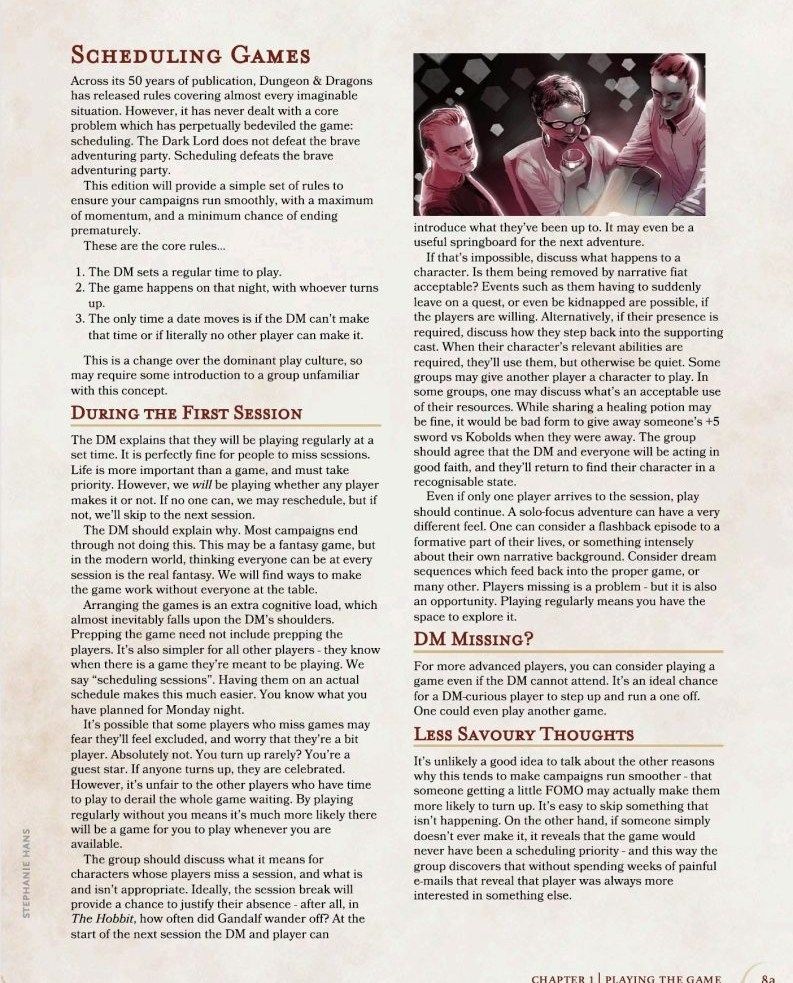
This week I saw a good take on scheduling for D&D.

https://www.polygon.com/tabletop-games/543536/dnd-dungeons-dragons-scheduling-handbook-patch

The Scheduling page the author suggests you print out

After I shared it, someone else sent me this Hank Green video about combinatorics, which explains the issue really well.

Ultimately, I think that people have trouble with D&D scheduling in part because of two of the Geek Social Fallacies: #5, “Friends Do Everything Together” and #1,  “Ostracizers Are Evil.”

But you don’t have to do everything together. Like I talk about in Nuclear Event Planning, it is okay to prioritize “I want to host this event” over “I want these specific people there.” (It’s also okay to do the reverse, but then you have to accept the high likelihood that “hosting the event” won’t happen.)

Geek Social Fallacies Again

I’ve been thinking about the Geek Social Fallacies again, and about Ostracizers Are Evil (fallacy #1).

This Reddit post summarizes it pretty well.

https://www.reddit.com/r/AbuseInterrupted/s/syogLYSwkV

It’s not wrong or evil or Just As Bad As The Bullies to ask someone to leave when they are being obnoxious.

People can, and do, learn and change and grow. But they’ve gotta DO those things.

And neurodivergence isn’t really an excuse; sometimes it’s barely even an explanation. Like they say about trauma: trauma isn’t your fault, but healing is your responsibility .

Ask Culture vs Microaggressions

A contrast crystallized for me today: One place where Ask Culture falls apart is in the concept of Microaggressions. There are, in fact, times when it is not generally okay to Just Ask, They Can Always Say No.

I feel like documenting microaggressions is a whole separate post that I’m not really qualified to summarize right here; but the go-to example of a microaggression is asking a Black person (out of nowhere) if you can touch their hair. Do not do this thing. It is not an okay thing to ask, even under an Ask Culture mindset.

It can be hard to know where the invisible lines are. But this one is pretty easy! But it might not be easy for everyone; hence the post.