I swear, the older I get the more I am circling back around to Christianity from the other side.
I’m still not there on the theology of a literal God or the supernatural. But I am 100% on board with the message of the Jesus of my childhood, in a church that had a Social Justice ministry before American conservatives made that a dirty word.
It doesn’t matter if the person telling you to care for the sick or stand up for what is right is Jesus or Gandalf or Kaladin Stormblessed. What matters is what you do with that advice.
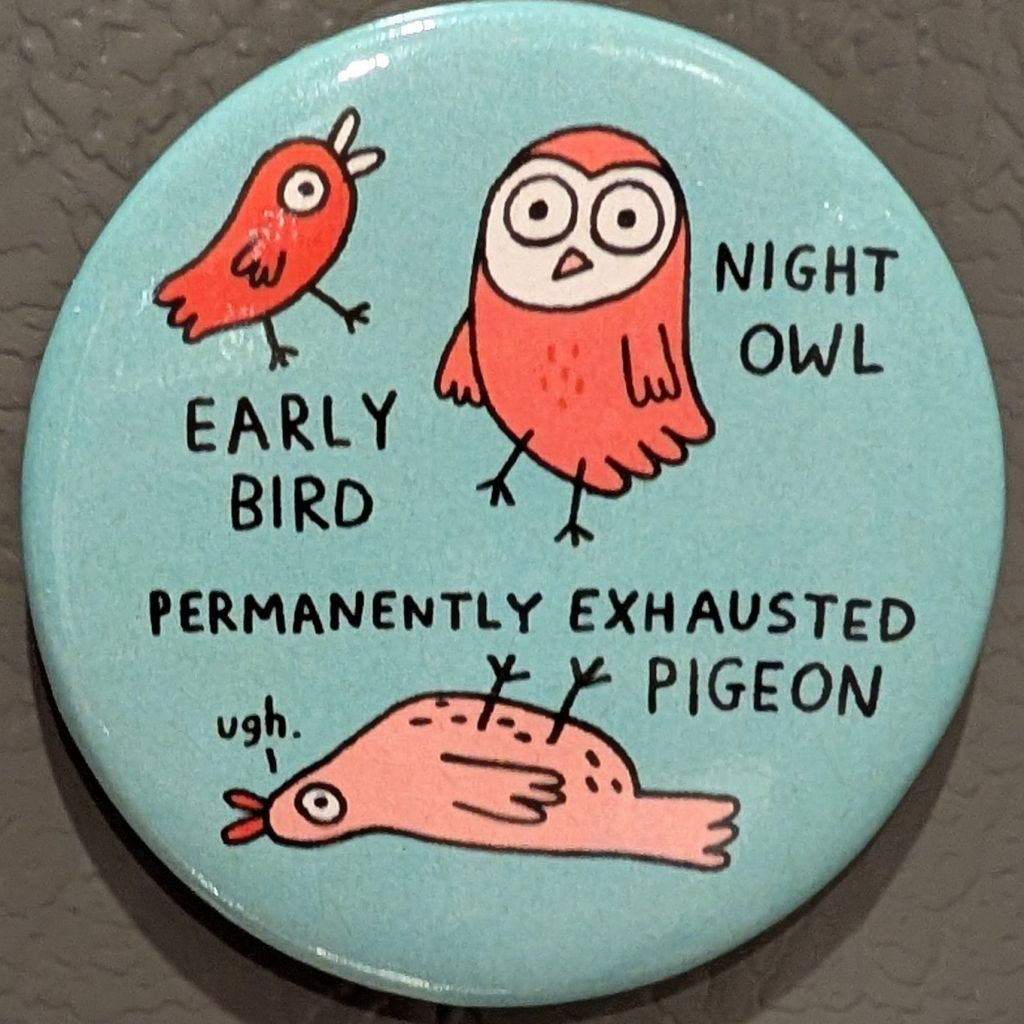
Some people are morning larks. They wake up early and go to bed early.
Some people are night owls. They stay up late and wake up late.
I have found, as I grow older, that I really need more sleep than I give myself. I can’t stay up until all hours of the night anymore, but waking up is still very difficult.
Per this magnet I found: I am clearly a Perpetually Exhausted Pigeon.
I realized today that a big part of why I never got into fanfic is that so much of it is so poorly edited I can’t get through it.
I almost put down ACOTAR because of “parameter” on page 1. I’m not exaggerating. (I instead got out a pen and corrected it.)
I read Manacled because the text was, by and large, legible. I bounced hard off another fanfic my friends recommended because it was not.
And I want to be clear: being like this does not make me morally superior. It just makes me someone who needs the writing to be basically invisible in order to suspend disbelief and immerse myself in the story. Poorly edited copy takes me out of that world as I try to figure out what the author was trying to say (usually by converting the letters into sounds in my head to guess what the homograph or malapropism was supposed to be).
I wonder if this is related to how, when I hear a word, my brain converts it into the visual “word on a page” in my head?
In the United States, General Electric is a good example of companies that used to ‘care about their employees.’ Of course, keep in mind that this is likely a matter of perspective, as Shareholder Supremacy has been the accepted law of the land since Dodge v. Ford Motor Company in 1919.
But to my main point, General Electric began its life as a company that built things (electronics on the like). It was a place where its workers could expect to spend their entire career in the service of GE and in return they would be given benefits and a pension upon retirement.
Without going into the rise of his career, Jack Welch became the CEO of GE in the 1980s. However, by 1981 he had effectively taken control of the company and removed most of the old guard (who had more or less believed in the old contract between employer and employee).
Welch more or less turned the company into mostly an investment firm. During his tenure from 1981 – 2001 GE’s market value grew from $14 billion to $600 billion.
However, a lot of that came at the expense of the employer employee contract. His tenure was associated with the end of pensions, reducing payroll (layoffs and reduced pay), rank and tank (firing the bottom 10% of employees), factory closures, and the expansion of stock options as well as utilizing stock options in lieu of pay for performance incentives. This mostly benefitted those at the top, including Welch himself whose pay was magnitudes above his workers.
During Welch’s tenure he was lauded as being a business genius. He was called “Neutron Jack” for his perceived success. Famously saying to judge him for how well the company was doing 20 years after he left.
Now, even by Wallstreet standards Welch’s ideas are seen as a failure. Ironically, $100,000 of shares from 2001 (shortly before Welch’s retirement) would have lost 80% of its value when adjusted for inflation by 2021. But it should be noted that GE’s stock currently sits near an all time high of $316.75 as of 12/25/25.
There is always more to say, but it’s the holidays, I’m on my phone, and I’m trying to keep it brief.
The Man Who Broke Capitalism: How Jack Welch Gutted the Heartland and Crushed the Soul of Corporate America―and How to Undo His Legacy by David Gelles, 2022
Winning by Jack Welch (with Suzy Welch), 2005
-Edited to fix typo regarding GE shares.
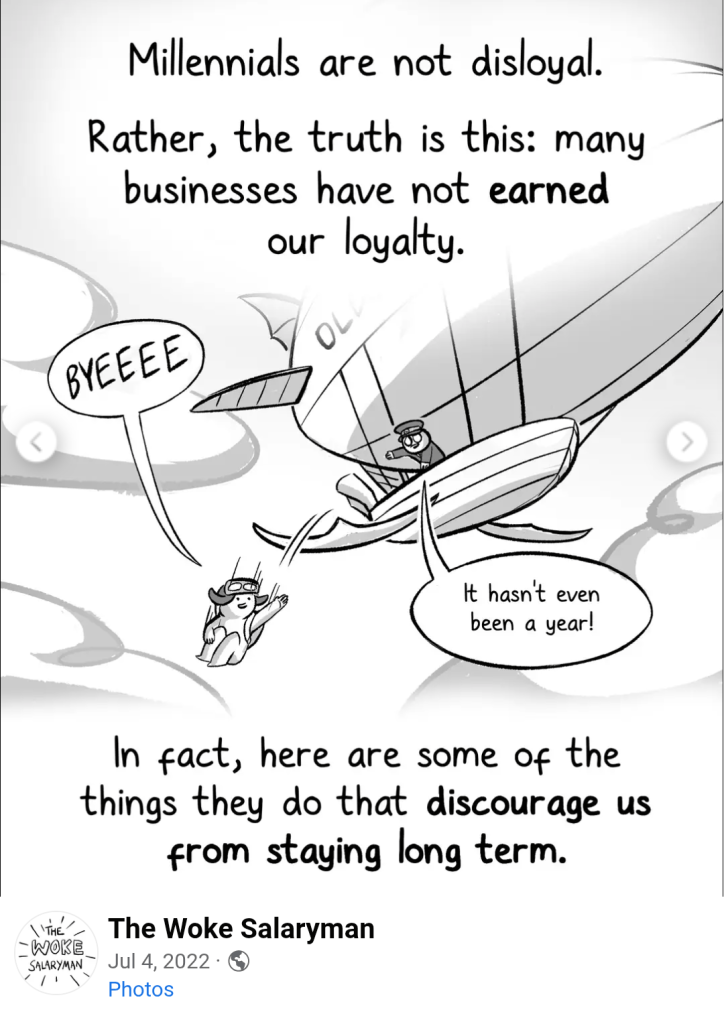
In my experience, I’ve had a number of older people express dismay that young folks have no more loyalty to their employer. (This is usually in the context of the tech industry and adjacent fields.) My rebuttal to this is usually that my generation saw our parents laid off from companies they’d poured their lives into, so it’s hard to feel loyalty to a company that doesn’t care about you.
When people talk about loyalty, it makes me think of the feudal system. Yes, knights swore loyalty to their liege lords; but the lords themselves swore fealty to protect their people, too. If you’re a lord and you don’t mobilize your army to defend against bandits, then soon you won’t have any farmers and you’ll starve in your castle.
Companies that want their workers to stick around need to make sure they are incentivized to do so.
At some point in my notes file, I wrote down this Tiktok link as a good explanation of the issue.
I’m not sure how to do a Facebook embed, but here’s a preview of this comic strip from The Woke Salaryman on Facebook.
It’s weird how many of these social networks I no longer use.
No one is going to have your interests first and foremost except for you. You owe your employer a duty of care, and a duty of confidentiality, but you don't owe them loyalty.
No one is going to have your interests first and foremost except for you. You owe your employer a duty of care, and a duty of confidentiality, but you don't owe them loyalty.


 Emilybook