Grand gestures

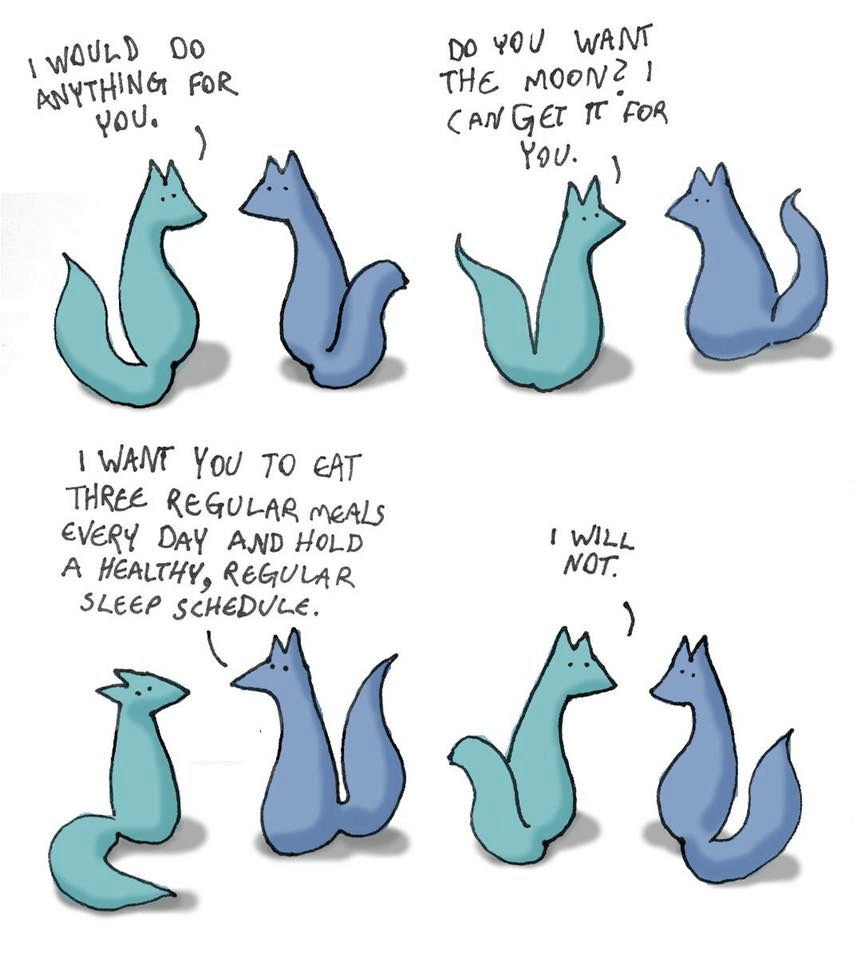
This week, I sent my therapist the following comic after our session because it was making me think.

Two foxes, discussing self-care (full alt txt later)

And I think something clicked for me today. We claim to want to make these grand gestures, because they are so impossible and so far away that we will never have to face the reality of doing them.

Doing small things, close to home, is both more effective and more scary. It’s scary because we’re afraid of the possibility that we might do them and they might not work. With the big things, we know they’re impossible; so the uncertainty of trying, and maybe failing, is blessedly absent. We can continue to go about our business, not doing either the epic or the mundane, with certainty.

Uncertainty is scary. It just is.

But throwing yourself into the mundane, and really doing your best at it, is so worthwhile. Yeah, you might fail. But you’re a rad person and you work hard. You’re pretty likely to succeed, too.

(Do I need a category for “embracing Hufflepuff” ?)

Teenage exceptionalism

When I was in high school, I think a junior or a senior, I read “Anthem” by Ayn Rand and “Harrison Bergeron” by Kurt Vonnegut, more or less back to back. I loved those stories. They fed into my sense of being uniquely special, like I was somehow above the more pedestrian order of my peers.

As I got older, I started to understand the political irony of enjoying those two authors. (I never read anything else by Rand, though I did go on to read more Vonnegut.) But as I grow older still, I’m starting to realize that the ideological space between them is not as wide as I had thought.

This week, I was talking to a friend who was shocked and horrified that I liked Anthem. (She saw through the pandering when she read it.) We discussed other books from our childhoods that had the same theme of “you are the best, you are the chosen one, no one understands you.”

Some of that just feels like normal Hero’s Journey stuff, right? Like, it’s innocuous. But if you dig deeper, you start to realize that there’s a pretty significant difference between Ender Wiggin and Frodo Baggins. “The ends justify the means” type stuff. (To be fair, Card did cover that in the sequels, before he really went off the deep end.)

And I know it’s weird, but once I started to think about that, I started realizing that over-identification with Ender was kind of a yellow flag in people I’d known in the past. Not always a red flag, not always a guarantee of rigidity in thinking and a need to be always right; but a yellow flag for sure.

For myself, I categorize this growing realization as my process of shifting from a Ravenclaw to a Hufflepuff. I don’t have to be the smartest one in the room anymore. (And, more importantly, by letting go of that need, I’m able to recognize when other people *are* smarter than me, and to learn from them! Anytime you’re the smartest person in the room you’re missing a huge opportunity.) What I have to do is work as hard as I can on the stuff I am good at, the stuff I am doing, and try to hold everything together in a world that sometimes feels like it’s spinning out of control.

Existing While Happy

I have a good relationship with my mother and with my daughter.

Today I’ve been talking with a friend about the difficulty of celebrating holidays like Mother’s Day, where everything is so fraught and there’s this constant background rhythm of “but what about the people with abusive mothers, what about the people who are infertile” and so forth.

I don’t have any good answers for this. This post is not an epiphany. But I think part of the issue might be the universality and inescapability of the Internet as a public square. I mean, think about Mother’s Day when I was a child. You spend the day at home with your parents, like you do. Maybe you go out to brunch. You telephone your grandma. If you’re missing a grandma, maybe you light a votive candle for her or something else in your tradition.

If you’re a person for whom Mother’s Day brings up painful memories, then you just avoid going out to brunch spots that morning. You don’t call your mom, for one reason or another different reason. It’s not possible to escape the Hallmark noise about mothers, but at least the raucous joy of your peers is muted for you, and you can have a quiet introspective day on your own.

But with the Internet, there is no quiet introspection; it is a binary. You can either have Everything All Of The Time, or you can have Nothing and sit in radio silence, alone. I think this goes triple during the pandemic; so much of our socialization is now online that shutting off the Internet feels like dying.

And along with that, I think there’s a subtle (or not so subtle) pressure to dial back our public-to-internet celebrations. But I think the distinction matters, between “I am celebrating in my own space” and “I am forcing you to celebrate in your space.” It’s just that the Internet blurs that distinction.

I don’t have any good answers for this. Like I said up top, there is no epiphany here.

  1. I love my mom.
  2. My daughter is the light of my life.
  3. I see the friends who have complex feelings today, and I respect their decisions regarding how to interact with the Internet during the month of May.
  4. GOTO 1.


Bonus content: this cat and her possum!

https://vm.tiktok.com/ZTdgsPDGJ/

Organ donation

Here is another short form post!

One of my strongly held personal beliefs is that organ donation after death should be mandatory, with religious exceptions allowed. Broadly speaking, it should be opt-out, rather than opt-in.

There is no coherent reason (again, other than religious ones, which I’m not required to understand) to not err on the side of saving lives rather than on the side of more embalmed flesh in the ground, not even allowed to rot and give its nutrients back to the ecosystem.

At the same time, I’m aware that this is a very minority opinion, and I don’t work too hard to convince people that I’m right. It is what it is, you know?

Old Bay and Crabs and Black-Eyed Susans

I live in Maryland. Despite my familial shellfish allergy, I really like it here!

But one thing that always bugs me is when people dump all over the state because they don’t like it.

Here’s the thing: A place, taken in isolation, is neither good nor bad. It simply is. The question of its value only comes in when somebody looks at the place and thinks: is this good for me?


I used to work with a junior airman who, one day, asked the world writ large: Why do they always build military bases in such shitty places?

After I stopped laughing, I explained to him that before the forts are built, these places are just random rural small towns. They don’t turn shitty until the local enterprising businessfolk realize there’s a profit to be made on the gullibility, fear, and desire of naive young men (and, nowadays, an increasing number of women!) concentrated in a single geographic region.

So when the base goes up, so do the tattoo parlors and massage parlors and strip parlors. Those places beget secondary effects, like payday loan places and pawn shops (which our quintessential junior enlisted might themself take advantage of). A military base is a force of concentrated poverty and desperation in a community, and that’s why we all think it’s bad. (And I am eliding, here, all the problematic things that make “us” think the stuff I listed there is “bad;” the only truly bad things I see in my list are the predatory ones. But that’s not the point of this post.)


So when I see people say “I hate Maryland,” I have a very different reaction than I used to. Before, I would get indignant and defend it. Tempers flare, as I’m sure you’re all shocked to hear. But now, I try to be more measured; and I try to make the point that it’s okay to prefer different geographical locations. It’s okay that you want to live in the Rockies or whatever, and that doesn’t reflect on my love for the Appalachians in any way.

Just please own that preference instead of acting like your preferences are the objective truth of the world, yeah? Thank you.

Analogies of Privilege

This post is a set of essays that I have read that explain privilege, and specifically poverty/class privilege, in ways that really make sense to me. I’ve tried to put them in approximately chronological order, but WordPress doesn’t seem to appreciate that.

Sam Vimes “Boots” Theory of Economic Unfairness (1993)

The theory can be found on the L-Space Wiki. It’s a great illustration of how starting off a little bit ahead can have a compounding effect into the future: buying quality things that last means you don’t have to spend more money on lower-quality things that need frequent replacement.

โ€œThe reason that the rich were so rich, Vimes reasoned, was because they managed to spend less money.

Take boots, for example. He earned thirty-eight dollars a month plus allowances. A really good pair of leather boots cost fifty dollars. But an affordable pair of boots, which were sort of OK for a season or two and then leaked like hell when the cardboard gave out, cost about ten dollars. Those were the kind of boots Vimes always bought, and wore until the soles were so thin that he could tell where he was in Ankh-Morpork on a foggy night by the feel of the cobbles.

But the thing was that good boots lasted for years and years. A man who could afford fifty dollars had a pair of boots that’d still be keeping his feet dry in ten years’ time, while the poor man who could only afford cheap boots would have spent a hundred dollars on boots in the same time and would still have wet feet.

This was the Captain Samuel Vimes ‘Boots’ theory of socioeconomic unfairness.โ€

Terry Pratchett, Men At Arms – Goodreads link

Being Poor (2005)

I read Scalzi’s “Being Poor” in 2005, after Katrina. It affected me a great deal, and – in a lot of ways – really put me on the road to being the person I am today, with regards to how I look at The Meritocracy and so forth.

Being poor is people who have never been poor wondering why you choose to be so.

The high cost of poverty: why the poor pay more (2009)

Great article in the Washington Post, from 2009, that really made me stop and think about my assumptions about thrift. You can’t save money by buying in bulk if you can’t afford to buy 64 rolls of toilet paper in the first place. Or if your apartment is too small to store bulk foods/paper products/etc. The article also goes into the nature of time costs for things.

Hard Mode (2012)

Learning about privilege is a hard thing. You really have to work at it, and you really need good analogies for it to make sense.

Some people refer to having privilege as playing life on the Default Mode, whereas people without a given axis of privilege are playing life on Hard Mode. (I’ll see if I can find the essay – got it!) John Scalzi’s Straight White Male: The Lowest Difficulty Setting There Is.

You can lose playing on the lowest difficulty setting. The lowest difficulty setting is still the easiest setting to win on. The player who plays on the โ€œGay Minority Femaleโ€ setting? Hardcore.

Of Dogs and Lizards (2010)

An essay that I absolutely adore, Of Dogs and Lizards, uses the old temperature wars as an analogy for privilege/misogyny. “I would like it if X happened, so why wouldn’t you?”

How to explain privilege to a broke white person (2014)

This is a classic essay from the Huffington Post, of all places: Explaining White Privilege to a Broke White Person. It explores the issues of class, which are often ignored in the superficial discourse we get about racism and other *isms in America. I do not personally subscribe to the Internet Socialist theory (not to be confused with actual thoughtful socialist theory!) that class is the only axis that matters, but a lot of people will use class as a confounding variable or a smokescreen to distract from issues of race and racial privilege; so it’s important to make sure we distinguish which kind of oppression/privilege we are talking about.

Siderea on Solidarity (2019)

I have a few Siderea essays in my list o’ things to put in this blog. One of them belongs here: Flunking Solidarity, or why Americans don’t talk about their salaries.

It is a deep and unquestioned part of American culture that Americans feel entitled to pass judgment on their fellow Americans’ worthiness to receive the most basic of resources.

Poor in Tech (2021)

Poor in Tech, by Meg Elison, is an essay about social class in the weirdly rarefied world of Silicon Valley and the tech industry writ large. There is also a MetaFilter thread about this one.

I knew I was the only poor person at my tech startup because I never got over not having to punch a clock.

Five Stupid Habits (est. 2012?)

The John Cheese essay, The 5 Stupidest Habits You Develop Growing Up Poor, is a great look at how our upbringing can shape our behavior – something that is very difficult to break.

This is a problem, because that’s actually a very shitty way to manage a budget. You skip over the great 2-for-1 deal on laundry detergent because you’re not out of laundry detergent yet. It’s kind of opposite of the way we bought food when I was a kid — where you should be stocking up because buying in bulk is cheaper and the stuff is on sale, you wait until you’re scraping the residue off the lid. Then you have to take whatever goddamned price the store gives you that day, because you can’t wash your clothes otherwise.
Mask reviews

My friend recommended these for if you need folks around you to be able to read your lips. Savewo 3DMASK Smile.

I personally found MaskLab a little bit too scratchy and stiff for my tastes, but the patterns are *so* cute. I wish they were softer! Or I was tougher!

Early on, I bought a big variety of masks from BeHealthyUSA.

Of them, I found Bluna to be my favorite (but also fairly difficult to get in my size).

Ilwoul was also good.

Dr. Puri was slightly less soft than Bluna, but still pretty good.

Blue, size Large, fit my husband okay but was too big for me.

I’ll try to keep updating this post as I get more data about what masks fit my face.

I’ll also make a second post about cloth masks.

With whatever bitter brew you’re drinking

I saw a lot of chatter on Twitter this morning about how Bezos “came from nothing,” and it really got me thinking.

We have a lot of ink spilled, in our society, over the idea of “meritocracy” and such. The idea is that if you work hard, you can have anything you want. “We don’t provide equality of outcome; just equality of opportunity.”

But even that platitude isn’t really true. People who say he “came from nothing” are talking about his working-class parents who worked hard, saved up money, believed in him, and helped him grow his business into a world-consuming empire. And here’s the thing: all those facts are true. They did work hard, all three of them, and they *did* make good decisions. I’m not contesting that. But I think we need to delve a little deeper into the negative space surrounding our view of American Success, because there’s a lot of it.

For a little bit of background on me: My mother’s family has lived in Virginia since the 1700’s. (I won’t say “since time immemorial” because we do remember, thank you very much.) We are the “hey, colonizer” guy’s interlocutors. (I wonder a lot about how our early family interacted with the locals. Allegedly it was friendly. But then, that’s the story we would tell, isn’t it?) For folks who know the difference between hillbilly and redneck, we’d probably be the latter (although I think only a couple of my cousins ID that way).

By contrast, my father’s family came to America from Eastern Europe in the 1920’s and 30’s. His maternal grandfather stayed in Jersey City and scrubbed toilets during the Great Depression (part of our founding mythos), but his paternal grandfather was a coal miner.

I’ve recently started going through a bit of a Mining Song Phase, and I kept feeling like a poseur because my mom’s family never had coal miners – we just weren’t that far west. We’re lowland farmers, and honestly we had it pretty damn easy compared to the folks in the mountains. My mom’s family was less fucked by the Great Depression than my dad’s family was, because at least they always had enough food to eat, because they grew it themselves. (My paternal grandfather had to stuff himself with bananas and drink a gallon of water in order to make weight for the CCC’s, in the same Founding Mythos that we have. He would have starved if he’d stayed at home, but his mom budgeted him some constipating food for that weigh-in.)

But then I remember: We were coal miners. It’s just that I don’t think about the “we” in the Northeast nearly so much as I think about the “we” in the southwest of Virginia.

And then I think about how damn lucky I am that my great-grandfather did, in fact, leave Harlan alive. Even when Harlan was McAdoo. If he’d died in the mines, his family would have been in even more dire straits.

We made good decisions. I’m not going to deny that. But we also had a healthy serving of luck, and I don’t want us to deny that either.

There’s a concept in psychology called the Just World Hypothesis. The idea is that if we make good decisions, then bad things won’t happen to us. I’m sure you can see the appeal of this idea already. But it is also called the Just World Fallacy, because as anyone over the age of 5 is aware, bad things still happen to good people. Believing otherwise is fallacious.

I think it’s natural to over-credit our own efforts, and under-credit the role of luck, in looking at our life outcomes. It makes us feel better. When we’re confronted with people who made good decisions but still had bad things happen to them, we feel bad and try to retcon the situation to convince ourselves that actually, those people made bad decisions. (This is separate from the philosophical tenant that even people who make bad decisions deserve to, e.g., have food to eat; I’m not addressing that idea in this post.) Retconning in this way restores our own sense of security and makes us feel safe again. But that doesn’t make it true.

Who am I trying to reach with this post? I don’t know. Maybe my own psyche. Maybe the world writ large. Maybe my dead ancestors. But for whatever reason, I needed to put it out there. Thank you for reading.