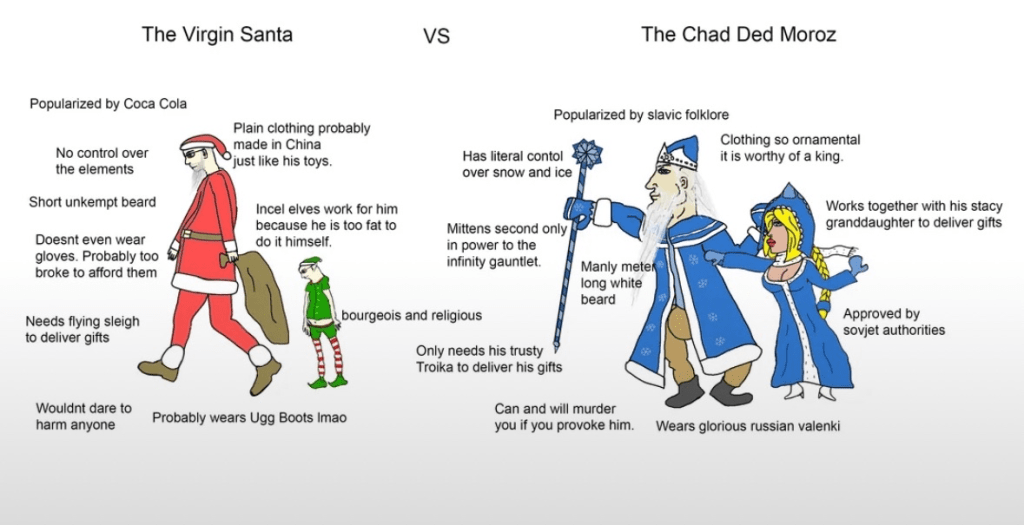
We just had Santa/Saint Nicholas, and another one…Black Piet, I think? Not the weird Dutch blackface one, but just a second Santa Claus figure who followed along dressed in black robes (not red) and had the job of handing out the coal to the bad kids (presumably so that Santa wouldn’t have to get his hands dirty, literally or metaphorically).
(Side note: Stardew Valley has made me see coal as a good present.)
I’m not sure if this was just my family’s adaptation of Krampus or what. But anyway, just wanted to share!
I think that the reason people treat blocking (on social media) as this Horrible Unforgivable Crime is that to them, social media feels like real life; and in real life, Shunning and Ostracism are genuinely punishments for horrible crimes.
But the Internet is not real life.
My half-baked hypothesis is that people think this way because young adults right now had their formative years during COVID, when things forced us online much more than even the most dysfunctional people, and it exacerbated and accelerated a lot of already-bad social trends.
This morning I read this post by YLE and it gives a very good explanation of why Denmark has a different vaccine schedule than the US does: most notably, universal healthcare and long guaranteed parental leave.
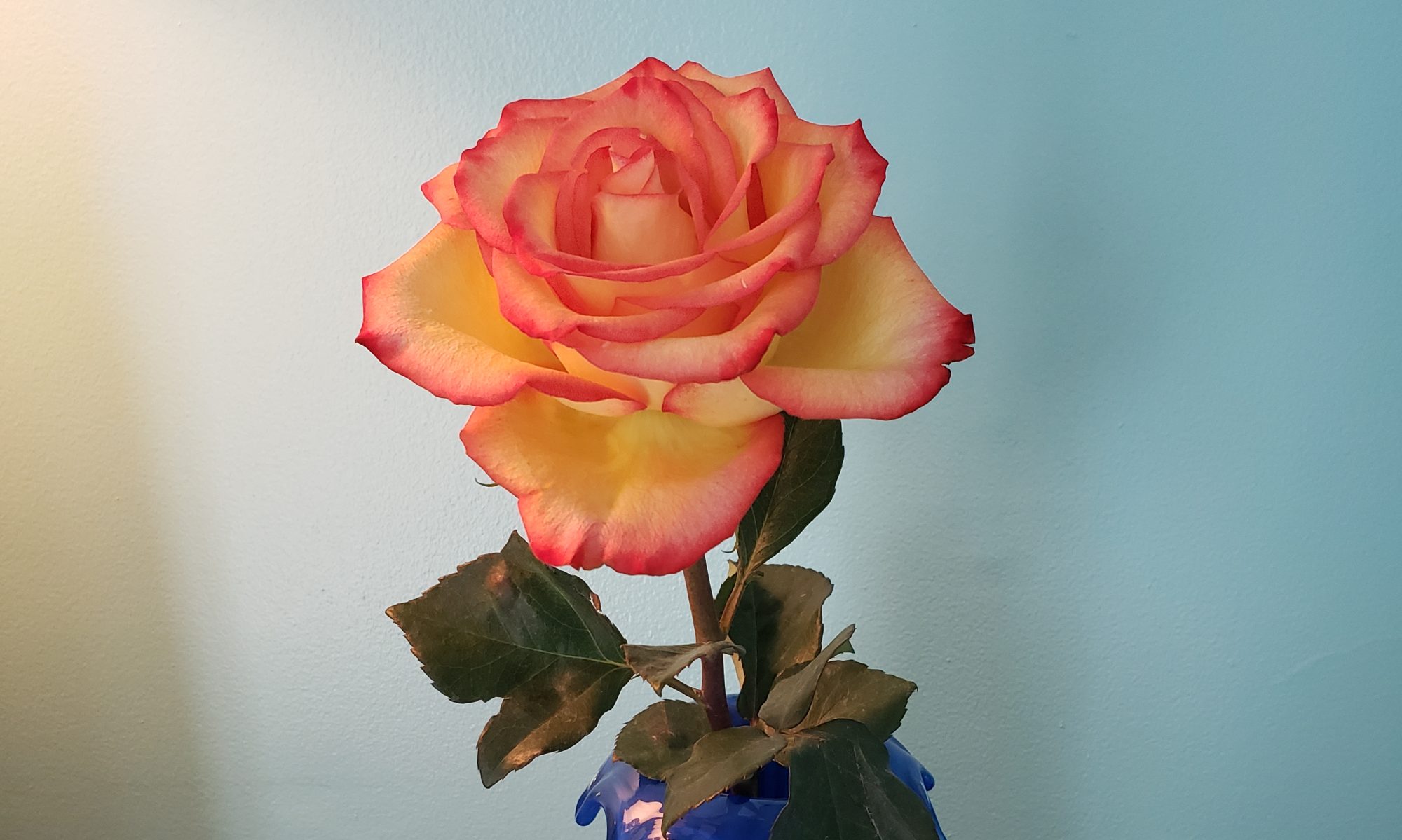
I have some knockout rose plants by my house. They’re not fancy, just cheap hybrids, but every year they produce beautiful flowers for me.
This year, in November, when everything was going dormant. the one closest to my door suddenly decided to produce a flower. I made a big deal about it – roses in November, The Last Rose of the Season, etc. I picked it and put it in a vase, and when it began to wilt I hung it up on the wall to dry.
Then, the rosebush made ANOTHER flower in December. It’s wilting right now in the front bed, in the most perfect “seven for beauty that blossoms and dies” dramatic pose.
And what I am taking from this is: There is no guaranteed Last Rose of the Season. Even something that you might think is final, is the end of all things, might not turn out to be.
And yes, it’s important to cherish those Maybe Lasts. When my daughter was in preschool, I thought often about “is this the last time I’ll be able to pick her up?” Children grow. I’m not a power lifter. There was, indeed, a last time.
But we never know exactly which one will be the Last. So cherish those moments; but never give up hope just because you think it’s the end.
I know this is contradictory, but contradictions are just the nature of the world, like roses in December.
(I’ve written and deleted about five paragraphs’ worth of Discourse about whether “nature” includes manmade things, and then I decided: let’s not. This is “nature” in the sense of “reality,” not in the sense of “a human didn’t influence this.” Humans are part of nature.)
Anyway. My point in all this is: Keep hope alive. Don’t give in to the despair. Allow the world to surprise you, and to be wacky and obstinate and uncaring about social or horticultural norms.
The way some media personalities talk about college campuses is absurd and fear-mongering, and I don’t appreciate it. I didn’t appreciate it in 2005 or so, when my own university was in the cross-hairs of the national conservative media apparatus, either.
There needs to be more recognition of nuance in the world. Harvard is not a “woke lions’ den,” as this guy puts it. We can and should continue to disagree on some subjects – nobody is advocating for groupthink! But the disagreements need to be based in realityand our shared humanity, and in a non-strawman understanding of what the other person thinks. (And I almost wrote “the other side,” but I also think it’s important to remember that these are *people* we are disagreeing with.)
This paragraph about his political strategy really stood out to me:
We approved a 1,500 percent increase in public health spending, expecting that a novel set of solutions — designed and driven by people who trust each other at the community level — will better reduce overall spending on health care. It costs less to keep people healthy than to intervene when they’re sick.
This is the way. And it’s heartening to see a Republican finally recognize that pre-emptive health care spending can save money AND lead to better lives for Americans in the long run. The myopic “does this benefit businesses in the next spending quarter?” attitude needs to go.
Contrary to my side’s worst fears, I found students from a wide range of circumstances. Harvard’s freshmen hail from all 50 states; one in five is a first-generation college student; half pay no tuition thanks to Harvard’s endowment; and 16 are military veterans.
However, this part made me laugh. Sir, your “side” thinks that level of diversity is a bad thing. It is their worst fears. (And they can’t keep the story straight about whether my “side” is Rich Woke Elitists or Greedy Resource-Hogging Poors, either.) So…clearly, he’s got some beams in his eyes that he still needs to work on. But overall, I applaud his spirit and attitude here. And this paragraph just goes to show, once more, the weakness of looking at this as “sides” rather than individuals.
I’m glad he gave Harvard a chance. And I’m glad to see sanity in this op-ed from someone I disagree with on most issues; and I’m glad to see that I agree with him on at least one issue.
I agree STRONGLY with this Tumblr post. People should be ABLE to work at the grocery store and make enough to support a family. That is how a functional society works. Grocery store workers (and other people in the service sector) are absolutely essential members of our society, and should not be disrespected and told that their jobs are only suitable for children.
A reflection on the value of low-ambition jobs in society, emphasizing the importance of fair wages for essential work.
(U) I used an AI assistant to generate alt text and a caption there. It did a good job. Interesting.
I used Google Drive’s Optical Character Recognition to OCR the text, so here’s that, too:
User “youthincare”:
people should be allowed to have low ambition, and also be able to feed a family on the salary of a cashier at a convenience store.
User “kidsomeday”:
My very first job was at Taco Bell, and most of us working there were horrible young adults with horrible young adult problems, but one of my coworkers was a woman in (I think) her 50s.
And us horrid young adults would ask her why she still worked at Taco Bell, because it was starter job and who would want to stay there forever? Her response?
“I make enough money to make sure I always have roses in my bedroom.”
This answer changed me as a person. It changed the way I thought about what makes someone successful, and made me step back and realize that I was so caught up in what I thought success and
happiness should mean that I didn’t know what I wanted them to mean.
Which is to say that sometimes ambition is making enough money to keep fresh roses in your bedroom, and you should be able to do that working at Taco Bell.
I like that.
And yes, low ambition means this person will never have a 7-bedroom house. That is OKAY. It is okay that not everyone will always be able to have the nicest and biggest things. But people should be able to have basic things on a basic salary: an apartment, health care, enough food to eat, access to information and education. It is a problem when people cannot have those things.
(And I know nobody argues with me anymore now that I’ve moved to this blog instead of Facebook; but if you want to go toe to toe on “frivolous” expenses, bring a real life budget and let’s dissect.)
Many years ago, my friend shared this Slate Star Codex essay with me. It really crystallized a lot of my feelings around the concepts of trans rights and how ultimately, we should be able to be good friends and neighbors to trans people even if we don’t understand them on a deep fundamental level.
It may not be the full-throated “how dare anyone believe anything else” defense of trans rights that many might prefer; but I actually find it more compelling for that very reason. (And it’s okay if your mileage varies on that. It’s not personal for me in the way it is for many of you.)
Today on the Internet I saw a post that said this:
Leave your church today.
Tithe by helping someone in need
God is not in a building
I replied:
Even when I was religious, I considered any charitable donation part of my tithe.
I have a still-religious friend who considers the portion of his taxes that go towards social welfare programs to be part of his.
There are many ways to be the Body of Christ in the world.
And I stand by that.
I should do that calculation myself, sometime. The back-of-the-envelope that I just did (62% of federal spending, 15% effective federal tax rate) gives me about 9% of my salary Helping People via taxes. That’s not too bad.


 Emilybook