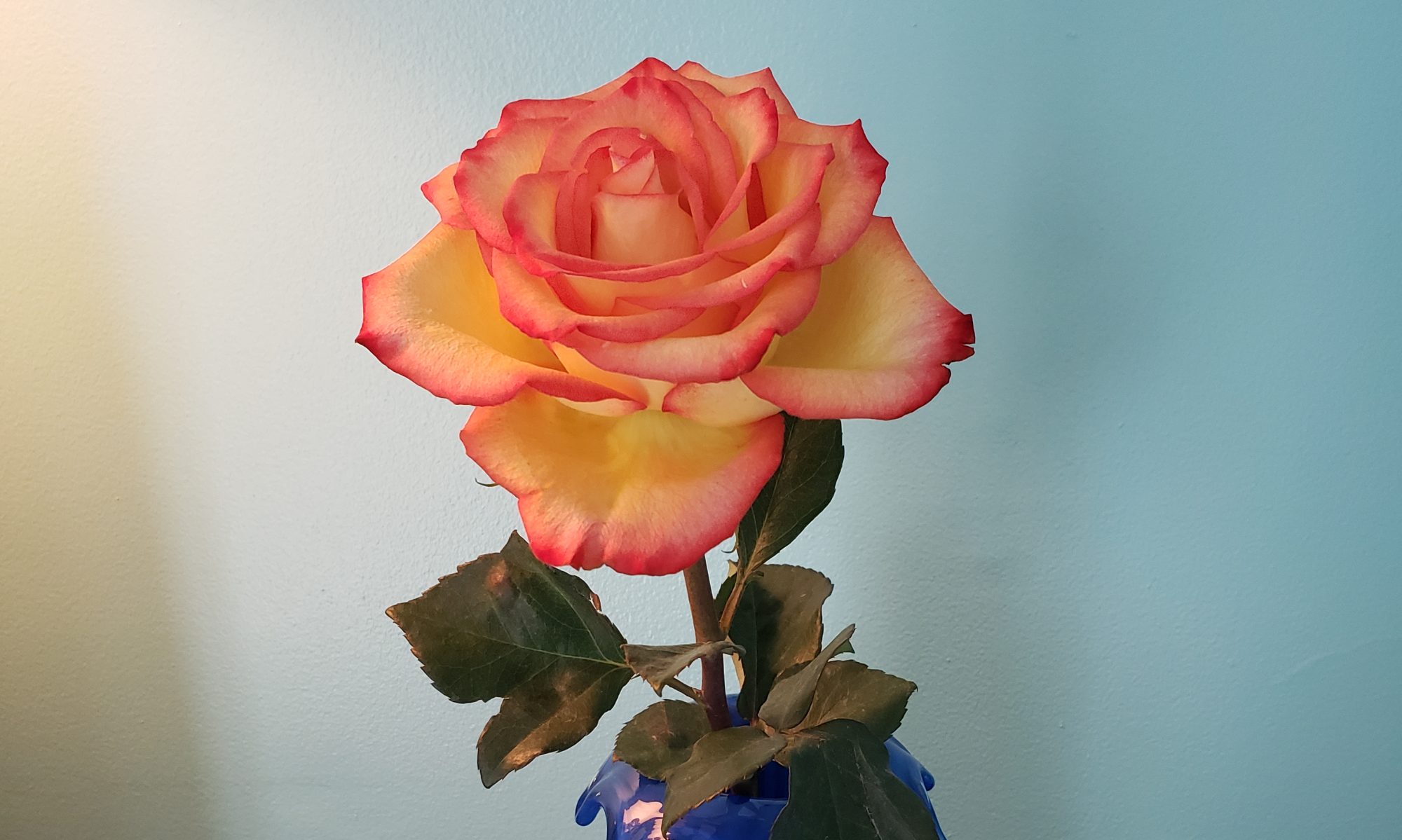
If you don’t air your dirty laundry, it grows mold.
The Advice Column Paradox
I didn’t invent this term, but I think it’s a really excellent one, so I’m going to share it here. If you have an earlier citation for the use of this phrase, please leave it in the comments!
The Advice Column Paradox: nobody writes into an advice column when things are going well.
The Advice Column Paradox: nobody writes into an advice column when things are going well. When we vent to our friends about our marriages, but don’t share the positive things, they may think things are worse than they are; but sometimes, there just aren’t positive things. (It’s why I always took pains to say “There’s good stuff too, I just don’t need help processing THAT” whenever we had these discussions. I try to be self-aware at least a little bit.)
It is very common to see, on Internet advice boards like r/relationships or r/AmITheAsshole, people complaining in the commenters always jump straight to “omg, divorce!” But what those people miss, I think, is the core of this paradox. If you are writing in to an Internet advice column, it is because something has gone wrong. Something may have gone so very wrong that they are writing in to an anonymous forum to ask for help. There is a strong possibility that they feel ashamed or afraid to ask the other people in their lives for help. The people who say “Modern couples are too quick to divorce” are either not saying that in good faith, or are ignorant of the fact of the Paradox. I don’t have a snappy name for this one; maybe we can call it the “Why So Much Divorce Corollary” or something.
Ultimately, this paradox and the corollary of people being confused by it is an example of selection bias. “You Should Break Up” being given as relationship advice is not overly common, percentage-wise; if half the advice column responses are “Break up!” and 1 in 100 people are writing into an advice column in the first place, then only half a percent of relationships are getting the “you should break up” advice. If you scale that out into the real numbers, it’s even smaller.
So, no: Advice column readers are not “too hasty” to tell people to divorce. And our culture is not somehow “devaluing” marriage by telling someone who is locked out of a bathroom while pregnant, or worse, that they need to leave to protect themself.
Rules, Agreements, and Boundaries
This post is another one where I mostly just link to someone else’s work and say “Hey! They make a really good point! Go read this!
Like so: Kimchi Cuddles: Rules, Agreements, and Boundaries
Let’s use the Billy Graham Rule as an example, because it’s atrocious, and thus nobody here will argue with me on the *merits* of the rule, so it stays all hypothetical.
In brief, the idea is that it’s not healthy to put a Rule on another adult. Instead, you can only choose to control your own behavior.
Rule: “You, Billy, cannot be alone in a room with another woman.”
The Rule tries to control what another person does.
Agreement: “We, Billy and Ruth, agree that we will not be alone in a room with a member of a different sex.”
The Agreement is something that two people agree to, together, about their behaviors.
Boundary: “Billy, if you ever spend time alone in a room with another woman, I will no longer spend time with you.”
The boundary is controlling your own behavior and your own response to the actions of others.
I think part of why Rule/Boundary gets blurred a lot is because of our whole cultural idea that marriage means two people become one unit. That’s a very romantic idea, of course; but it’s not practical even as a metaphor. Even in a marriage, we remain separate individuals with our own needs and wants. (I recently had someone try to tell me that legal marriage makes two people legally one entity, which, LOL nope. That’s not how that works at all.) One heart cannot hold all of this.
As a coda: Kimchi Cuddles is an explicitly non-monogamous comic, but I’ve appreciated it for a long time. I find it has a lot of observations that apply just as well for monogamous people as they do for non-mono folks.
Some of the comments in this Reddit post are also pretty on point. It’s not possible for another person to “break” your boundaries. There’s a verb that’s more applicable to the direct object “rules.” If someone violates your boundaries, then you just proceed with the action that you said would happen when your boundary got crossed. You can’t control the other person. You can’t push with a rope. You can only control your own actions, and reactions, and so forth.
Astrology variant: Seven Bells
Someone on Reddit made a post about “which of the Seven Bells are you?” – from the Sabriel series – and it’s delightful.
Anyway, I’m Dyrim.
Grand gestures
This week, I sent my therapist the following comic after our session because it was making me think.
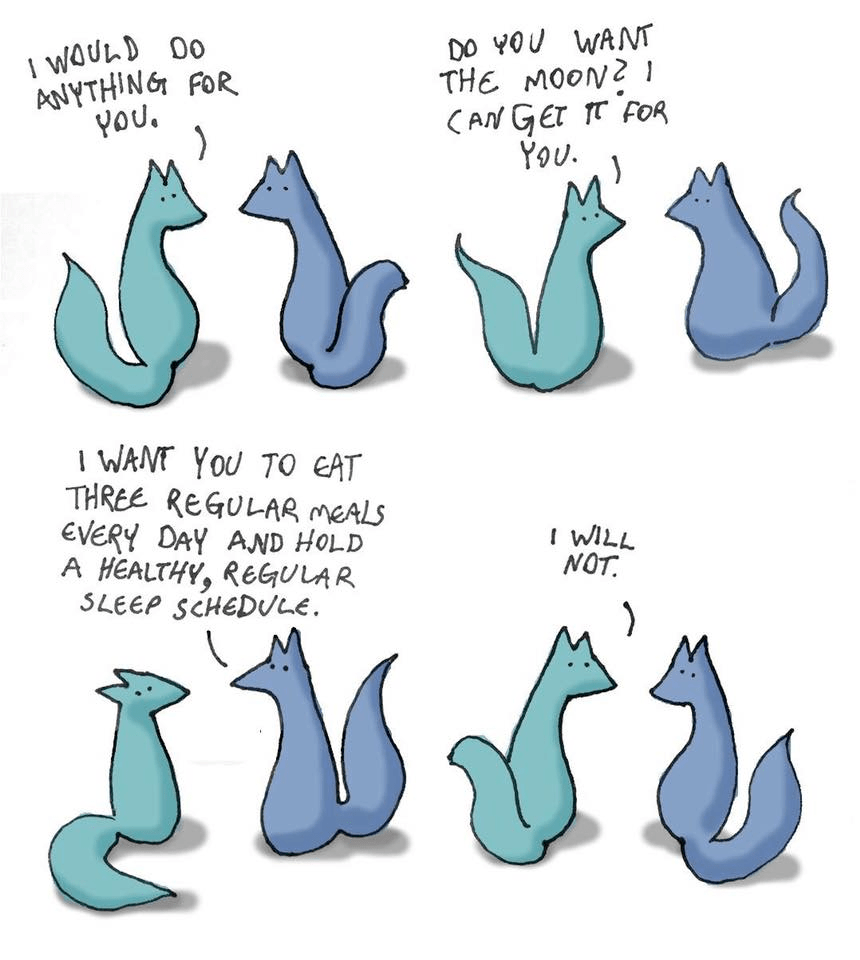
And I think something clicked for me today. We claim to want to make these grand gestures, because they are so impossible and so far away that we will never have to face the reality of doing them.
Doing small things, close to home, is both more effective and more scary. It’s scary because we’re afraid of the possibility that we might do them and they might not work. With the big things, we know they’re impossible; so the uncertainty of trying, and maybe failing, is blessedly absent. We can continue to go about our business, not doing either the epic or the mundane, with certainty.
Uncertainty is scary. It just is.
But throwing yourself into the mundane, and really doing your best at it, is so worthwhile. Yeah, you might fail. But you’re a rad person and you work hard. You’re pretty likely to succeed, too.
(Do I need a category for “embracing Hufflepuff” ?)
Teenage exceptionalism
When I was in high school, I think a junior or a senior, I read “Anthem” by Ayn Rand and “Harrison Bergeron” by Kurt Vonnegut, more or less back to back. I loved those stories. They fed into my sense of being uniquely special, like I was somehow above the more pedestrian order of my peers.
As I got older, I started to understand the political irony of enjoying those two authors. (I never read anything else by Rand, though I did go on to read more Vonnegut.) But as I grow older still, I’m starting to realize that the ideological space between them is not as wide as I had thought.
This week, I was talking to a friend who was shocked and horrified that I liked Anthem. (She saw through the pandering when she read it.) We discussed other books from our childhoods that had the same theme of “you are the best, you are the chosen one, no one understands you.”
Some of that just feels like normal Hero’s Journey stuff, right? Like, it’s innocuous. But if you dig deeper, you start to realize that there’s a pretty significant difference between Ender Wiggin and Frodo Baggins. “The ends justify the means” type stuff. (To be fair, Card did cover that in the sequels, before he really went off the deep end.)
And I know it’s weird, but once I started to think about that, I started realizing that over-identification with Ender was kind of a yellow flag in people I’d known in the past. Not always a red flag, not always a guarantee of rigidity in thinking and a need to be always right; but a yellow flag for sure.
For myself, I categorize this growing realization as my process of shifting from a Ravenclaw to a Hufflepuff. I don’t have to be the smartest one in the room anymore. (And, more importantly, by letting go of that need, I’m able to recognize when other people *are* smarter than me, and to learn from them! Anytime you’re the smartest person in the room you’re missing a huge opportunity.) What I have to do is work as hard as I can on the stuff I am good at, the stuff I am doing, and try to hold everything together in a world that sometimes feels like it’s spinning out of control.
Existing While Happy
I have a good relationship with my mother and with my daughter.
Today I’ve been talking with a friend about the difficulty of celebrating holidays like Mother’s Day, where everything is so fraught and there’s this constant background rhythm of “but what about the people with abusive mothers, what about the people who are infertile” and so forth.
I don’t have any good answers for this. This post is not an epiphany. But I think part of the issue might be the universality and inescapability of the Internet as a public square. I mean, think about Mother’s Day when I was a child. You spend the day at home with your parents, like you do. Maybe you go out to brunch. You telephone your grandma. If you’re missing a grandma, maybe you light a votive candle for her or something else in your tradition.
If you’re a person for whom Mother’s Day brings up painful memories, then you just avoid going out to brunch spots that morning. You don’t call your mom, for one reason or another different reason. It’s not possible to escape the Hallmark noise about mothers, but at least the raucous joy of your peers is muted for you, and you can have a quiet introspective day on your own.
But with the Internet, there is no quiet introspection; it is a binary. You can either have Everything All Of The Time, or you can have Nothing and sit in radio silence, alone. I think this goes triple during the pandemic; so much of our socialization is now online that shutting off the Internet feels like dying.
And along with that, I think there’s a subtle (or not so subtle) pressure to dial back our public-to-internet celebrations. But I think the distinction matters, between “I am celebrating in my own space” and “I am forcing you to celebrate in your space.” It’s just that the Internet blurs that distinction.
I don’t have any good answers for this. Like I said up top, there is no epiphany here.
- I love my mom.
- My daughter is the light of my life.
- I see the friends who have complex feelings today, and I respect their decisions regarding how to interact with the Internet during the month of May.
- GOTO 1.
Bonus content: this cat and her possum!
Wisdom from TikTok
“A person is only as good as how they treat you when they are angry with you.” Via DomesticBlisters. https://vm.tiktok.com/ZTdVPryYn/
Organ donation
Here is another short form post!
One of my strongly held personal beliefs is that organ donation after death should be mandatory, with religious exceptions allowed. Broadly speaking, it should be opt-out, rather than opt-in.
There is no coherent reason (again, other than religious ones, which I’m not required to understand) to not err on the side of saving lives rather than on the side of more embalmed flesh in the ground, not even allowed to rot and give its nutrients back to the ecosystem.
At the same time, I’m aware that this is a very minority opinion, and I don’t work too hard to convince people that I’m right. It is what it is, you know?
Retail cashiers should be allowed to sit down.
That’s it. That’s my opinion. If you disagree, I’m very curious to discover why. What effect does it have on you if they’re allowed to rest their feet instead of standing all day?

