You don’t become cooler with age, but you do care progressively less about being cool, which is the only true way of being cool. This is called the Geezer’s Paradox.
Found via this Mastodon link: https://mastodon.sdf.org/@obster/111142670514548111
I Want A Wife
Not me. I don’t want to remarry! But the title of this post is from a famous essay from back in the 70s about how much domestic and emotional labor the role of “wife” provides, and how even after women* entered the workforce en masse in the 70s, all of that labor still had to be performed by…the wife half of any heterosexual couple.
TikTokker Laura Danger reads the text
Labour, by Paris Paloma:
Spoon Theory
One of the things I’ve read that really changed my way of thinking about the world was the essay commonly known as Spoon Theory. I spent basically my entire youth as a completely able-bodied person, and while I had theoretical compassion for people with disabilities, I had no gut level understanding of what it was like to live with a disability. Reading this essay in college (or possibly shortly thereafter? I can’t recall exactly when it was) helped me understand why so many people couldn’t “just” do something or other.
Understanding disability is just one step along the road to understanding the whole system of intersectionality and how everybody’s lives are (or can be) different from one’s own. Not every essay will resonate with every person, and that’s okay. I hope this one helps you understand it a little bit better.
As I find them along the way, I’ll try to add links to this post to other versions of Spoon Theory that I’ve read, written by people who found the original metaphor to be limiting or inaccurate. One such alternative metaphor is a D&D one that uses “Spell Slots” as the day-limited resource that a disabled person must shepherd.
And that reminds me that some people with chronic illness refer to themselves/each other with the affectionate term “spoonie.” Now I’m wondering if a goofy bard with a chronic illness would refer to themself as a Spoony Spoonie.
I like it!
This column is a great defense of having your own sense of taste or style or whatever.
As a side note, I would like to observe that the author’s use of “basic” doesn’t line up exactly with the usage that implies “middle to upper class white woman with UGGs and a cup of Starbucks.” Here, the given examples are a little lower class than that.
Which is NORMAL. Living like that is NORMAL. This is how most people live their lives.
Intersectionality and Misogynoir
Saw a TikTok today that explains Misogynoir (the name for the specific oppression that Black women face) in a very simple way (“for cavemen”).
At some point I’ll write a little more about intersectionality and what that means, but for now, I’ll just share this.
Word of the day: closed practice
A little while ago, I heard about a useful term for discussing the issue of cultural appropriation versus appreciation: closed practice.
In brief (others can link to longer explanations if they wish), the idea is that some things are a Closed Practice (that only people in that culture can really appreciate and participate in), and other things are an Open Practice (anyone is free to do the thing, without censure from anyone except overly enthusiastic 14yos on Tumblr).
As an example: tattooing is not a Closed Practice. Many, many cultures have tattooing as a tradition, and it’s not appropriation to get a tattoo. However, there may be specific tattoos that would be considered closed practices. Like something related to a coming of age ritual, or similar.
I’m not using specific real examples in this post, because I don’t want to get bogged down about one culture or another. But in general, if you’re trying to have a good faith discussion with someone about whether a given thing is appreciation or appropriation, ask: Is this a closed practice or an open practice?
Best friends

I’ve had best friends before.
One, or six, or fourteen at a time?
At this stage in my life, I think the whole concept of a best friend is children play-acting at monogamous marriage before they’re ready or interested in a romantic relationship with anyone.
I still remember the agonizing feelings I had when someone else got to be The Best Friend when I wanted to be.
And I remember the guilt I felt when I drifted apart from my closest friend of childhood. Was I, somehow, divorcing her?
I’ve had “friend breakup” talks, as an adult. They were painful, but a necessary part of being compassionate to someone you once (and still) care(d) about.
One of my friends in college told me, “Best Friends isn’t a single job; it’s a tier.” I didn’t believe her then. I do now. (And her husband is the person I’d pick if I was forced to pick a single best friend, which is an amusing bonus anecdote.) For the most part, I don’t have a single best friend; I have a rotating cast of friends who are all close to me in different ways. One friend is my local emergency contact for everything. The other (aforementioned) is my advance directive POA. Yet another pair are the designated guardians for my child in case both my ex husband and I pass away.
A friend today shared a post about how “best friend” is a term that imitates monogamy, and it made me think about all this. (I don’t have the link handy, but I’ll add it when I do.) It’s been percolating in my mind for a while, but I haven’t really put it into words.
It’s not realistic to expect one person to be all those friends for you; different people are different, and every dyadic friendship has its own shape. They don’t take away from each other, except inasmuch as time and energy are limited things.
I am grateful, though, for all the friends that I do have, and for all the friends I used to have. You have all touched, shaped, my life in one way or another.
I’m glad that I don’t have to pick one friend to be a Best Friend.
On parenting adult children, and estrangement
Recently, my browser decided to give me this article from Psychology Today.
Why your adult child treats you like dirt
It gives some really thoughtful suggestions for the parents who actually do want to reconnect with their children, and who are willing to be introspective and to think about what their behavior may have contributed to the current situation.
Continue reading “On parenting adult children, and estrangement”Geek Social Fallacies
Something I reference a lot is the essay from a few years back: the Geek Social Fallacies.
My personal demon is #4 (Friendship is Transitive), but I’ve seen all of them at play in my social groups, so it’s good to remember them periodically.
Rules and Boundaries, cat edition

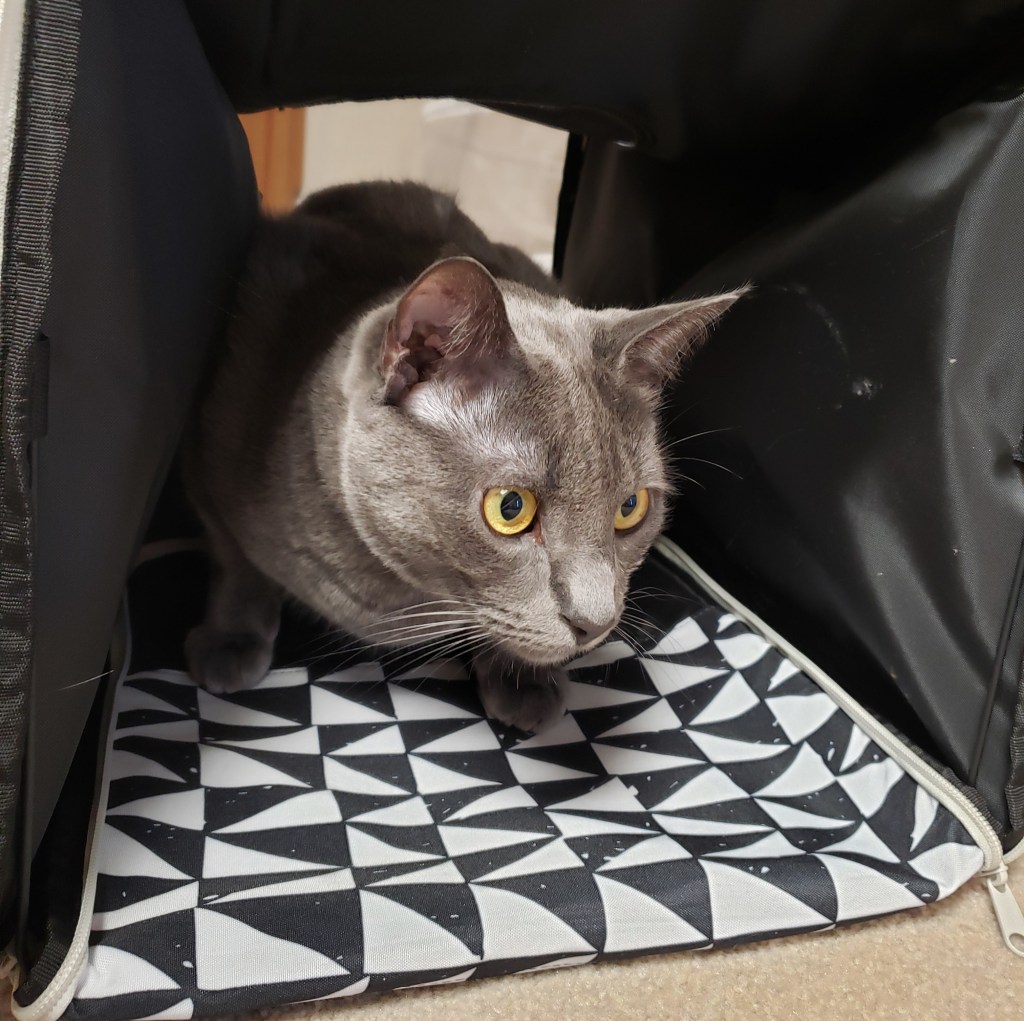
Last night, I accidentally taught my kid about the difference between Rules and Boundaries by using my cat as an example. See, my cat (Cloud, 2M) is a bit of an asshole sometimes. He likes to jump up on my dresser while I’m sleeping and bat things around and make noise. As a result, I’ve started locking him out of my bedroom at night, so that I can have good sleep hygiene (a serious issue for me right now in my life).
So last night, my daughter was like “Why are you punishing him? He’s just being a cat!” And, you know, she’s right! But also, I have the right to sleep without disturbance. So I launched into the explanation that I cannot control Cloud, but I can control what doors are open or closed in my house.
Then, I realized that this was a perfect way to segue into the difference between making rules for someone else versus setting a boundary for your own self!
I emphasized that I cannot control Cloud or his actions myself. I can say ”stay off the dresser” until I’m blue in the face, but ultimately I’m not the one that controls his actions. What I can control is my actions. I can lock him out of my room in order to be healthy and get enough sleep. That’s within my locus of control.
Then I drew a parallel to a real life conundrum she might face someday: say, dating a person who is a smoker. She can say “You can’t smoke in my house.” She can say “If you smoke, I will break up with you.” But she can’t say “You are not allowed to smoke.” That’s not within her locus of control.
Anyway. I hope this lesson sticks with her as she grows up and makes her own way in the world.
 Emilybook