Money is not morality
While shooting the breeze with a friend tonight I realized that “Poor people are degenerates” and “Don’t tell me I can’t afford something I ought to be able to afford!” attitudes are two sides of the same coin.
The first position, commonly associated with rich assholes who think they are self-made, is a mistake because it assumes that someone’s income or wealth is solely a factor of their moral character, i.e. their willingness to work hard to accomplish their goals. However, that is not the case. Not all hard work is equally remunerated; the free market doesn’t care how hard you work, but only about the supply and demand of your skill. It’s fundamentally amoral. (Remember, don’t confuse “amoral” with “immoral.”) This is also the primary reason why we should not trust in the market to take care of people. The market does not care if you live or die.
The second position, which I see more in people on my side of the political aisle, is born out of a place of frustration and anger. It’s the idea that “if I can’t buy a house on 30% of my income, then that guideline is wrong and bad and shaming! Don’t shame me!” But having or not having money is not (or shouldn’t be!) a locus of shame or pride. It’s just a matter of numbers. But people see “you can’t afford to buy a house yet,” and they take it as a moral attack on their value as human beings.
Neither of these attitudes are good. If you find yourself falling into either one, please try to remind yourself: money is not a measure of your inherent worth as a human being.
How do you know what you want?
One of my friends recently wrote on Facebook “how do you know what you want?” and I ended up writing a fairly long response. Posting it here, too.
You know, one of my friends just asked me this too, and I don’t know the answer for sure.
I think part of it was after a young lifetime of being a perfectionist and also a people-pleaser, I had to get good at satisficing or I was going to burn out. Going to progressively more difficult environments (high school to college to a job) meant that I was surrounded by an increasing concentration of people smarter than me, and that was something my ego had to adjust to. But learning that I actually *wasn’t* always the smartest person in the room also freed me from having to always Be The Very Best. I could just be Good Enough, and that was okay too.
So I was able to apply that to my own decisions as well. Is this thing the Absolute Best Option I Could Possibly Choose? Well, maybe, maybe not. But the marginal benefit of obsessing over Relentless Optimization is so stressful to me that I had to Just Pick Something.
And now that I think more about this: I think I cut my teeth on this skill with choosing restaurants with friends as a young adult. I get hangry when I don’t eat (it doesn’t seem to be a disorder, I just have/had a fast metabolism), so when people started dithering about where to go, it meant that I was risking a fainting+nausea spell. So I started doing Executive Decision Making for the whole group, and for the most part it turned out fine. Some people don’t like me telling them what to do, but Oh Well Their Loss.
Like a lot of skills, practicing in small ways helps build up the muscle (literal or metaphorical) for bigger tasks.
Anyway, IDK if this is what you were asking about, but I hope it helps! 
Character idea
I am blatantly stealing this from a friend of mine.
I want to play a buddhist lupine that used to sell trinkets seeking an outfit that truly reflects themselves from a pier
They’re an aware weir ware where wear werewolf
Ten Essentials
My friend recently shared this resource from the National Park Service, about ten essential items you should bring with you whenever you are hiking.
The Rural Idyll Fallacy
A couple years ago I was complaining about people who romanticize The Countryside™️, and coined (?) the term “Rural Idyll Fallacy.”
Basically, it’s that if many people move to an uncrowded rural area, it becomes crowded and loses the charm that drew folks to migrate there.
(As a side note: development needs to be carefully planned! Dense urban development with transit + old town areas continuing to exist is much better than miles and miles of cookie-cutter foam mansions sitting in former cow pastures. A McMansion doesn’t get better if you put it on 2 acres of monocrop fine fescue. Now get off my lawn, I want to grow a forest again.)
Enough is, in fact, enough: a meditation on Pieces of Flair
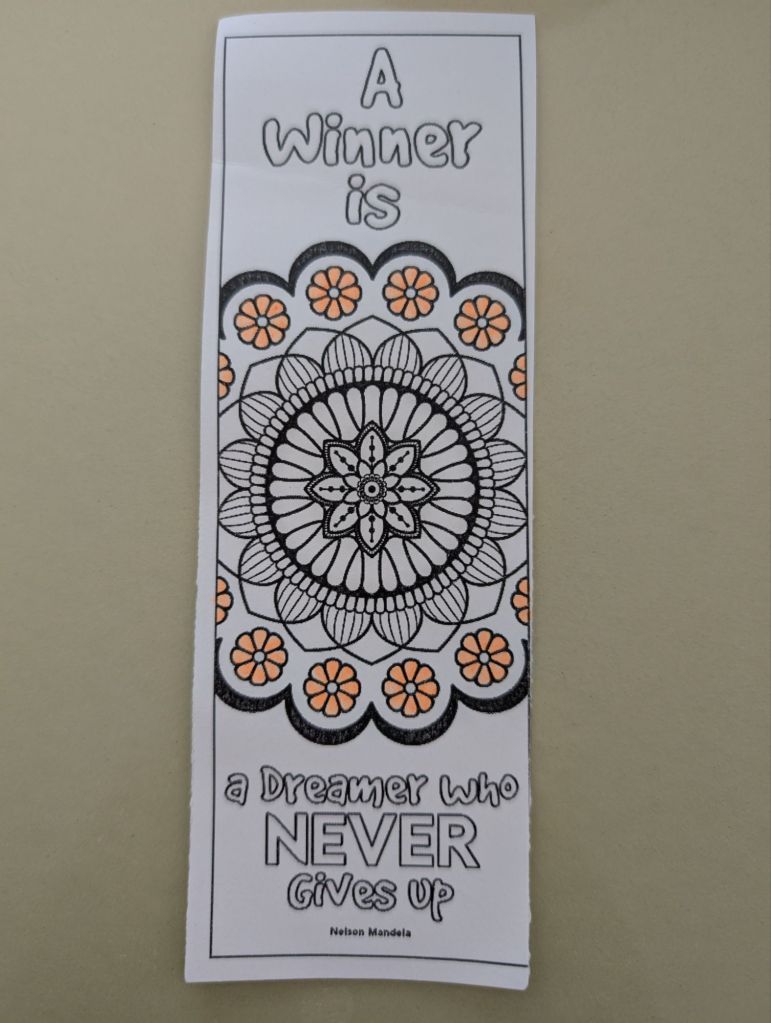
Today I was coloring in a bookmark that had the quippy little motivational message, “A Winner is a Dreamer who Never Gives Up.” — Nelson Mandela
“A Winner is a Dreamer who Never Gives Up.”
Nelson Mandela
And it made me think: is that really accurate? No, it’s not. Or, more to the point: it’s incomplete. A winner is a dreamer that never gave up and also scored better than all of the other dreamers who also never gave up.
But that doesn’t make the non-winner any less worthy of respect and admiration!
I have always hated the old “joke” about “What do you call the guy who graduates last in med school? Doctor!” Frankly, I don’t care what my doctor’s rank in a classroom setting 30 years ago was; I care that they know enough to be a doctor. If this person was actually too stupid to be a doctor, they would not have graduated.
Likewise, and I think we’re better at recognizing this side of things, an Olympian who doesn’t win a medal is still a goddamn Olympian. The person who finishes last in a marathon still ran a goddamn marathon. That’s far more than any of the armchair haters will ever accomplish.
Being told you have to be the best just to be good enough is a stupid (and, frankly, toxic) attitude to take. Do the thing. Do it well. Don’t worry about your relative ranking compared to others.
(Bonus note: this is also what I told my fellow new parents when my daughter was a 99th percentile chonker. Everyone has to be somewhere on the percentile chart, and every percentile has to be filled. It’s just the pigeonhole principle. It’s not a referendum on the quality of your baby.)
A new silly astrology question
Instagram apparently knows I love corporate astrology! I got recommended this video, about asking your partner if they’re a fairy, a witch, a princess, or a mermaid.
I can’t remember which is which and my Instagram timer has run out for the day, but I think I’d say “witch.”
https://www.instagram.com/reel/DK8Ec4PSYFm/
Which one are you? And what do you think it says about yourself?
(Don’t bring this to your next office mixer though.)
On Dobson
A friend’s priest had this to say, on the passing of James Dobson:
“On behalf of “strong-willed children” everywhere: There is no one I credit more for all my emotional and spiritual trauma than James Dobson.
I believe he is now fully in the presence of the radical love of God he so consistently preached against. My hope is that in the fullness of time he will be reconciled to that love.
In the meantime, sucks to be him.”
Imagine the torment it must be, to go your whole life believing in a God of hatred and exclusion, only to discover upon your death that your God is actually a god of love.
If hell is the absence of God? And this man is now feeling that absence, because God does not condone violence towards young children, the way Dobson does (well, did)? Then Dobson is in hell.
Good.
Aging dummy thicc
I’ve been mulling over the word “thick” or “thicc” lately. Like a lot of slang, I’m pretty sure it originated in Black English, and is generally seen as a compliment. But when I think about who it’s applied to, I think it’s generally just specific body types that are thicc (fat in an acceptable way), in the most common usage of the word.
As I’ve been getting older, most of my weight gain has been centered on my belly. Sometimes folks still ask if I’m expecting. It’s stopped hurting, but it’s always jarring.
But I think about that, about the fact that I have a thick waist/belly and no noticeable hips or butt and minimal (though finally, beautifully, extant) boobs; and I think of the phrase “unfashionably thick.”
But then I think more about that phrase. It’s the sort of thing you might see in a fantasy novel that has a female protagonist: where “unfashionably thick” is just code for “she’s conventionally attractive in our world, but not in her own.” And I think the word for my middle aged wine mom lib body is “thick, in the unfashionable way.”
But it is still mine; and I am grateful to have it.

